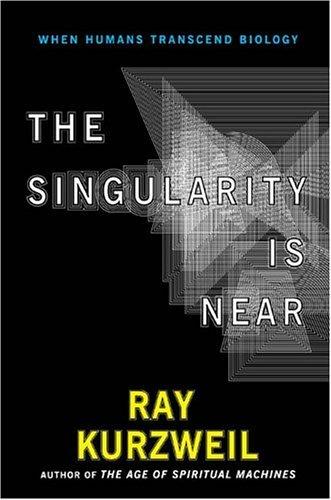
Talk to The Singularity Is Near like its author wrote you back.
Get the ideas that fit your life — not generic summaries.
- Chat with the book
- Audiobook-style main ideas
- Adapts to your life and goals
- Helps you take action
What it argues
The Singularity Is Near is Ray Kurzweil's forecast that the exponential growth of information technology — computing power, storage, bandwidth, and the reverse-engineering of the human brain — will produce a technological singularity around 2045: a point at which artificial intelligence surpasses human intelligence in all relevant domains, beyond which we cannot reliably predict what happens. Kurzweil argues this is not science fiction but the extrapolation of well-documented technological trends.
The book's foundation is the law of accelerating returns, Kurzweil's broader generalization of Moore's Law. Moore observed in 1965 that transistor density in integrated circuits doubled roughly every two years. Kurzweil argues this is one instance of a broader pattern: the time to the next paradigm shift in computing hardware has been roughly constant for over a century across different computing substrates — relay computers, vacuum tube computers, transistors, integrated circuits. The rate of information technology progress is itself accelerating, compounding on itself.
What it gets right
- 1.
The law of accelerating returns: information technology has doubled in capability at roughly constant time intervals across multiple hardware paradigms, and this trend shows no sign of stopping.
- 2.
The singularity — the point at which artificial intelligence surpasses human intelligence — is Kurzweil's projection for around 2045, after which human history as we know it effectively ends and something qualitatively different begins.
- 3.
The human brain is a hierarchical pattern-recognition system whose functional architecture can be reverse-engineered from increasingly detailed brain scans. Kurzweil projects this will be complete in the 2020s.
What it covers
Who wrote it
Ray Kurzweil is an American inventor, futurist, and author who has been a director of engineering at Google since 2012. His inventions include the first flatbed scanner, optical character recognition systems, and music synthesizers. He is the author of several books on artificial intelligence and the future, including The Age of Intelligent Machines and The Singularity Is Nearer. He is known for his predictions about technology, many of which have been broadly correct in direction if not always in timing. Kurzweil has been described as the successor to Thomas Edison and the ultimate thinking machine by observers of different persuasions.
