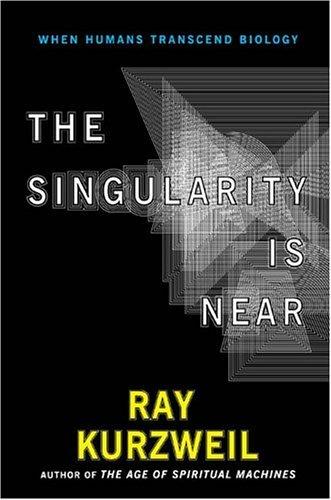
The Singularity Is Near by Ray Kurzweil is a 2005 science book about artificial intelligence, technological progress, transhumanism. The law of accelerating returns: information technology has doubled in capability at roughly constant time intervals across multiple hardware paradigms, and this trend shows no sign of stopping.
Summary
The Singularity Is Near is Ray Kurzweil's forecast that the exponential growth of information technology — computing power, storage, bandwidth, and the reverse-engineering of the human brain — will produce a technological singularity around 2045: a point at which artificial intelligence surpasses human intelligence in all relevant domains, beyond which we cannot reliably predict what happens. Kurzweil argues this is not science fiction but the extrapolation of well-documented technological trends.
The book's foundation is the law of accelerating returns, Kurzweil's broader generalization of Moore's Law. Moore observed in 1965 that transistor density in integrated circuits doubled roughly every two years. Kurzweil argues this is one instance of a broader pattern: the time to the next paradigm shift in computing hardware has been roughly constant for over a century across different computing substrates — relay computers, vacuum tube computers, transistors, integrated circuits. The rate of information technology progress is itself accelerating, compounding on itself.
Kurzweil applies this framework to biology and to intelligence. He argues that the human brain is a pattern-recognition machine of a specific architecture — the neocortex as a hierarchy of pattern recognizers — that will be fully reverse-engineered in the 2020s as brain scanning improves. Once we have the functional architecture, we can implement it in silicon, then improve it beyond biological constraints. The result, by around 2045, is machine intelligence vastly exceeding human capability.
The book is exhaustive, sometimes exhaustingly so: over 700 pages with extensive notes, responses to critics, and speculation about future medicine, economics, and consciousness. Kurzweil is optimistic to a degree many find implausible: he expects to live long enough to upload his mind, merge with AI, and eventually spread human-level intelligence through the universe. Critics, including many AI researchers, argue that he conflates the continuation of hardware trends with the much harder problem of actually building human-level AI, and that his timelines are driven more by extrapolation than by understanding the specific challenges involved.
Talk to The Singularity Is Near like its author wrote you back.
Get the ideas that fit your life — not generic summaries.
- Chat with the book
- Audiobook-style main ideas
- Adapts to your life and goals
- Helps you take action
Key takeaways
- 1.
The law of accelerating returns: information technology has doubled in capability at roughly constant time intervals across multiple hardware paradigms, and this trend shows no sign of stopping.
- 2.
The singularity — the point at which artificial intelligence surpasses human intelligence — is Kurzweil's projection for around 2045, after which human history as we know it effectively ends and something qualitatively different begins.
- 3.
The human brain is a hierarchical pattern-recognition system whose functional architecture can be reverse-engineered from increasingly detailed brain scans. Kurzweil projects this will be complete in the 2020s.
- 4.
Intelligence merging: Kurzweil expects humans to augment their biological intelligence with AI systems, eventually merging with machine intelligence rather than being replaced by it.
- 5.
Exponential growth is counterintuitive: the first 30 steps of doubling are modest; steps 31 through 60 produce more total progress than all the preceding steps combined. Most people underestimate where exponential curves go.
- 6.
Three converging revolutions — GNR: genetics, nanotechnology, and robotics — will transform medicine, manufacturing, and intelligence simultaneously over the coming decades.
- 7.
The hardware shortfall for human-level AI is not the core obstacle: cognitive architectures, training approaches, and the gap between narrow and general intelligence are the hard problems, and Kurzweil's book underestimates them.
- 8.
The singularity is not necessarily dangerous in Kurzweil's account: he envisions a future of extraordinary abundance, health, and capability rather than the extinction scenarios that other AI thinkers consider.
Discussion questions
Use these on your own, with a book club, or as chat starters in Superbook. Book club version, ready to copy or print →
- 1.
Kurzweil extrapolates from hardware trends to conclude that human-level AI will arrive around 2045. Is extrapolation from past trends a sound method for predicting fundamental technological discontinuities?
- 2.
The law of accelerating returns has correctly predicted hardware trends. Does that track record support applying it to much harder problems like general intelligence?
- 3.
He argues that the brain is a pattern-recognition hierarchy that can be fully reverse-engineered. Does that seem like a complete account of what the brain does?
- 4.
Kurzweil is optimistic about the singularity; other thinkers — Bostrom, Musk, Hawking — are alarmed. What accounts for the difference in outlook?
- 5.
What would it mean for intelligence to 'merge' with AI? Is that the same as uploading your mind?
- 6.
The book was published in 2005. How has the subsequent development of AI — deep learning, large language models, GPT-4 — affected its specific predictions?
- 7.
Kurzweil responds to many critics in the book. Does reading those responses change your assessment of the specific objections?
- 8.
If the singularity is coming regardless of what any individual or government does, what are the implications for how we should invest in AI safety research?
- 9.
Kurzweil expects to merge with AI and potentially live indefinitely. How do you respond to that ambition — is it inspiring, disturbing, or simply implausible?
- 10.
The book is very long and covers economics, biology, physics, and philosophy, not just AI. Does that breadth strengthen or dilute the central argument?
- 11.
Moore's Law has slowed in recent years. Does that slow the singularity, or does Kurzweil's law of accelerating returns allow for hardware paradigm shifts that restart the trend?
- 12.
What specific prediction in the book do you now know turned out correct or incorrect?
Themes
Frequently asked questions
-
What is the technological singularity?
A hypothetical future point at which artificial intelligence surpasses human intelligence in all relevant dimensions, making further human-guided progress difficult to predict. After this point, history would become, in Kurzweil's framing, incomprehensible from a pre-singularity perspective — hence 'singularity,' borrowed from the mathematical term for a point at which a function becomes undefined.
-
Has Kurzweil been right about his predictions?
He correctly predicted the growth of the internet, the decline of Soviet power, wireless internet, and various hardware trends. Some specific predictions are off in timing. His overall track record on technology hardware trends is strong; his predictions about AI capabilities have been more uneven.
-
Is the book too long?
Most readers find it too long. The core argument is clear by the first quarter; the remainder elaborates, responds to critics, and speculates about post-singularity society. Readers primarily interested in the singularity thesis can focus on the first third.
-
Is Kurzweil an AI researcher?
He is primarily an inventor and entrepreneur with deep expertise in pattern recognition and speech recognition. He has a different background from academic AI researchers, which partly explains why his framework — emphasizing hardware scaling and brain reverse-engineering — differs from mainstream AI research priorities.
-
What do AI researchers think of the book?
Mixed. Some find the exponential growth trend analysis valuable and the hardware predictions largely correct. Most are skeptical of the specific cognitive architecture claims and the 2045 timeline for AGI, arguing that Kurzweil underestimates the difficulty of the problems that hardware scaling alone cannot solve.
Similar books
Superintelligence: Paths, Dangers, Strategies
Nick Bostrom
Life 3.0: Being Human in the Age of Artificial Intelligence
Max Tegmark
Human Compatible: Artificial Intelligence and the Problem of Control
Stuart Russell
Pale Blue Dot: A Vision of the Human Future in Space
Carl Sagan
