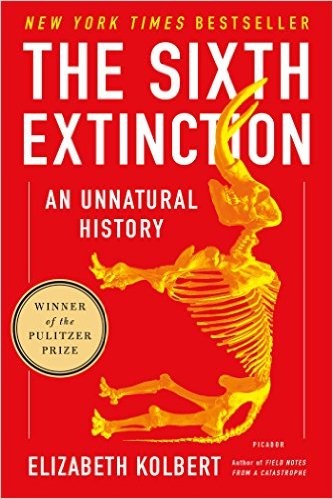
Talk to The Sixth Extinction: An Unnatural History like its author wrote you back.
Get the ideas that fit your life — not generic summaries.
- Chat with the book
- Audiobook-style main ideas
- Adapts to your life and goals
- Helps you take action
The Sixth Extinction: An Unnatural History, in detail
The Sixth Extinction is Elizabeth Kolbert's account of the mass extinction event currently underway — the sixth in Earth's history, and the first caused by a single species. Kolbert spent years traveling to field sites around the world, accompanying scientists studying species in active decline: frogs in Panama, bats in upstate New York, rhinos in Sumatra, corals in the Great Barrier Reef. The result is a book that makes an abstract global crisis legible through a series of vivid, specific encounters.
The structure is roughly historical. Kolbert opens with the concept of extinction itself, which scientists didn't accept until Cuvier proved it from fossils in the late 18th century. She then traces the five previous mass extinctions — the end-Ordovician, the late Devonian, the end-Permian, the end-Triassic, and the end-Cretaceous — before turning to the present. What connects all five to the sixth is the speed of change. Evolution can adapt to gradual shifts; it cannot adapt to catastrophic ones. The asteroid that ended the Cretaceous was catastrophic. So is the rate at which humans are now altering oceans, atmosphere, and land.
Each chapter focuses on a different dimension of the crisis. Ocean acidification is dissolving the calcium carbonate shells that reef-building corals depend on. Habitat fragmentation strands species in isolated patches too small to sustain viable populations. The global movement of people and goods has introduced invasive species and pathogens to ecosystems with no evolutionary defenses — including the chytrid fungus that has driven more than a hundred amphibian species to extinction in decades. Kolbert is careful throughout to let the science speak: she quotes researchers rather than editorializing, and the accumulation of detail does the work that polemic would do less effectively.
The book does not end with solutions. Kolbert resists the temptation to pivot from crisis to action plan. The final chapter pulls back to the broadest perspective: humans are a geological force, unprecedented in the history of life, and the species losses accumulating now will shape evolution on this planet for millions of years. That's a sobering conclusion, and Kolbert doesn't soften it. Readers who want a roadmap will find this frustrating. Readers who want to understand the scale of what's happening will find it indispensable.
The big ideas
- 1.
We are living through the sixth mass extinction in Earth's history, the first caused by a single species rather than asteroid impact or volcanic activity.
- 2.
The previous five mass extinctions were caused by catastrophic, rapid environmental change. The current one is accelerating because of how quickly humans are altering oceans, atmosphere, and land.
- 3.
Ocean acidification, driven by CO2 absorption, is dissolving the calcium carbonate structures that coral reefs depend on — threatening ecosystems that support roughly a quarter of all marine species.
