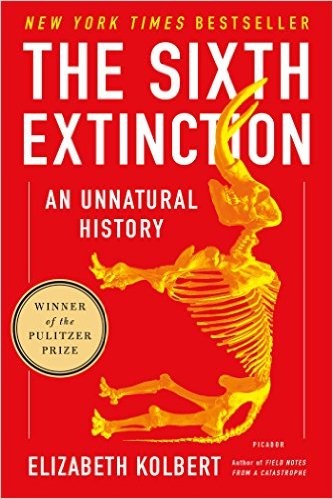
The Sixth Extinction: An Unnatural History by Elizabeth Kolbert is a 2014 science book about extinction, climate change, biodiversity. We are living through the sixth mass extinction in Earth's history, the first caused by a single species rather than asteroid impact or volcanic activity.
Summary
The Sixth Extinction is Elizabeth Kolbert's account of the mass extinction event currently underway — the sixth in Earth's history, and the first caused by a single species. Kolbert spent years traveling to field sites around the world, accompanying scientists studying species in active decline: frogs in Panama, bats in upstate New York, rhinos in Sumatra, corals in the Great Barrier Reef. The result is a book that makes an abstract global crisis legible through a series of vivid, specific encounters.
The structure is roughly historical. Kolbert opens with the concept of extinction itself, which scientists didn't accept until Cuvier proved it from fossils in the late 18th century. She then traces the five previous mass extinctions — the end-Ordovician, the late Devonian, the end-Permian, the end-Triassic, and the end-Cretaceous — before turning to the present. What connects all five to the sixth is the speed of change. Evolution can adapt to gradual shifts; it cannot adapt to catastrophic ones. The asteroid that ended the Cretaceous was catastrophic. So is the rate at which humans are now altering oceans, atmosphere, and land.
Each chapter focuses on a different dimension of the crisis. Ocean acidification is dissolving the calcium carbonate shells that reef-building corals depend on. Habitat fragmentation strands species in isolated patches too small to sustain viable populations. The global movement of people and goods has introduced invasive species and pathogens to ecosystems with no evolutionary defenses — including the chytrid fungus that has driven more than a hundred amphibian species to extinction in decades. Kolbert is careful throughout to let the science speak: she quotes researchers rather than editorializing, and the accumulation of detail does the work that polemic would do less effectively.
The book does not end with solutions. Kolbert resists the temptation to pivot from crisis to action plan. The final chapter pulls back to the broadest perspective: humans are a geological force, unprecedented in the history of life, and the species losses accumulating now will shape evolution on this planet for millions of years. That's a sobering conclusion, and Kolbert doesn't soften it. Readers who want a roadmap will find this frustrating. Readers who want to understand the scale of what's happening will find it indispensable.
Talk to The Sixth Extinction: An Unnatural History like its author wrote you back.
Get the ideas that fit your life — not generic summaries.
- Chat with the book
- Audiobook-style main ideas
- Adapts to your life and goals
- Helps you take action
Key takeaways
- 1.
We are living through the sixth mass extinction in Earth's history, the first caused by a single species rather than asteroid impact or volcanic activity.
- 2.
The previous five mass extinctions were caused by catastrophic, rapid environmental change. The current one is accelerating because of how quickly humans are altering oceans, atmosphere, and land.
- 3.
Ocean acidification, driven by CO2 absorption, is dissolving the calcium carbonate structures that coral reefs depend on — threatening ecosystems that support roughly a quarter of all marine species.
- 4.
Habitat fragmentation is as dangerous as outright destruction. Isolated patches of habitat too small to support viable populations doom species as surely as deforestation.
- 5.
The chytrid fungus, spread globally by the movement of humans and animals, has driven more amphibian species to extinction in recent decades than any other pathogen in recorded history.
- 6.
Extinction is not uniform. Islands, tropical forests, and freshwater ecosystems are disproportionately hard hit because species there tend to be geographically limited and evolutionarily vulnerable to novel threats.
- 7.
Species losses happening now will shape the trajectory of evolution on Earth for millions of years. The decisions made in this century are effectively permanent on any human timescale.
- 8.
The concept of extinction itself had to be invented. Before Cuvier's work in the late 18th century, the prevailing view was that God would not allow any of his creations to disappear.
Discussion questions
Use these on your own, with a book club, or as chat starters in Superbook. Book club version, ready to copy or print →
- 1.
Kolbert reports without prescribing solutions. Did that choice make the argument more or less persuasive for you?
- 2.
The chytrid fungus spread globally through the movement of people and goods. What other invisible vectors of harm do we carry without knowing it?
- 3.
Kolbert describes scientists who spend careers studying species likely to vanish within their lifetimes. What kind of psychological posture does that work require?
- 4.
The book argues that habitat fragmentation can be as lethal as outright destruction. How does that change how you think about development, roads, and land use?
- 5.
Ocean acidification is called the 'evil twin' of climate change — receiving far less attention despite comparable consequences. Why do some crises get less attention than their scale warrants?
- 6.
Kolbert notes that the concept of extinction had to be proven. Before Cuvier, people assumed continuity. What assumptions about continuity might future generations have to dismantle?
- 7.
The sixth extinction is driven by a species with the cognitive capacity to understand what it's doing. Does awareness carry moral weight, and if so, how much?
- 8.
Which species or ecosystem Kolbert describes stayed with you most? What does that reaction tell you about how we allocate concern?
- 9.
The book ends without solutions. Is that an honest reckoning or an abdication? What would a solutions chapter have needed to say to be credible?
- 10.
Kolbert compares human impact to an asteroid strike in its geological consequences. Is that comparison clarifying or distorting?
- 11.
How does the scale of millions of years of evolutionary consequence change how you think about political and economic choices made on timescales of years or decades?
- 12.
The book treats extinction as irreversible. De-extinction research suggests otherwise for some species. Does that prospect change the urgency of prevention, or is it a distraction?
Themes
Frequently asked questions
-
Is The Sixth Extinction worth reading?
Yes, particularly if you want to understand the biodiversity crisis at a level beyond headlines. Kolbert's field reporting makes abstract statistics concrete, and the writing is clear without being simplified. Readers who prefer data-heavy treatments may want to supplement it, but as an introduction to the scope of the problem it is hard to beat.
-
How long does it take to read The Sixth Extinction?
Around five to six hours at average reading pace for the 319-page book. The chapters are organized around individual species or ecosystems, making it easy to read in sections rather than straight through.
-
What is The Sixth Extinction mainly about?
It argues that human activity — habitat destruction, ocean acidification, invasive species, and climate change — is driving a mass extinction event comparable in scale to the five previous mass extinctions in Earth's history, and that the losses will shape the trajectory of life on this planet for millions of years.
-
Who should read The Sixth Extinction?
Anyone who wants a well-reported, science-grounded account of the biodiversity crisis. It works well for general readers, book clubs, and students. It is less useful as a policy guide — Kolbert deliberately avoids prescriptions — but essential for understanding why the problem is serious.
-
Does the book offer solutions?
No. Kolbert is explicit about this. The book ends with a sober accounting of what is being lost, not a roadmap for prevention. Some readers find that frustrating; others find it more honest than books that pivot to optimism without earning it.