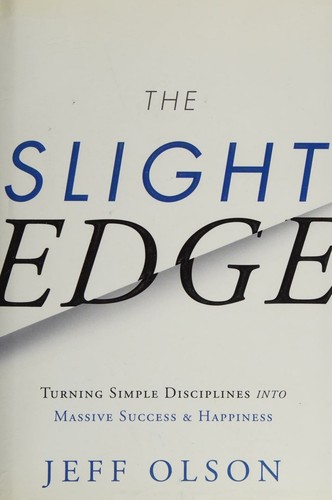
Talk to The Slight Edge like its author wrote you back.
Get the ideas that fit your life — not generic summaries.
- Chat with the book
- Audiobook-style main ideas
- Adapts to your life and goals
- Helps you take action
What it argues
The Slight Edge is Jeff Olson's philosophical account of why some people succeed over time while others don't — and his answer is not talent, intelligence, or opportunity but the daily practice of small, easy actions. Olson's core observation is that the actions that produce extraordinary results over time are simple, accessible, and easy to do. The problem is that they are equally easy not to do. And because they seem so small and the results are so distant, most people don't do them consistently.
This is the Slight Edge: the gap between the person who does the small things daily and the person who doesn't. The gap is invisible in the moment — a single day's difference between reading ten pages and watching television is negligible. But compounded over five years, it is the difference between a significantly different body of knowledge and capability. The trajectory that looks flat in the short term becomes dramatically different in the long term.
What it gets right
- 1.
The Slight Edge is the compounding advantage produced by doing small, easy things consistently over time. The actions are easy to do and equally easy not to do — the discipline is choosing to do them anyway.
- 2.
Success and failure are both built from simple daily disciplines, repeated consistently over time. There is no dramatic turning point; there are only daily choices that eventually become visible as trajectories.
- 3.
The activities that produce the most long-term value are the easiest to skip in the short term — they seem too small to matter today. This is the trap: they never seem to matter today, but they always do eventually.
What it covers
Who wrote it
Jeff Olson is an entrepreneur and network marketing executive who built and sold several companies in the direct sales industry before writing The Slight Edge. He developed the philosophy of the Slight Edge from his observations of the differences between people who succeeded and failed in business over decades of work. The Slight Edge, first published in 2005 and updated in 2013, became a widely circulated book in entrepreneurial and personal development communities. Olson also founded The Beryl Institute and serves as an advisor to several companies.
