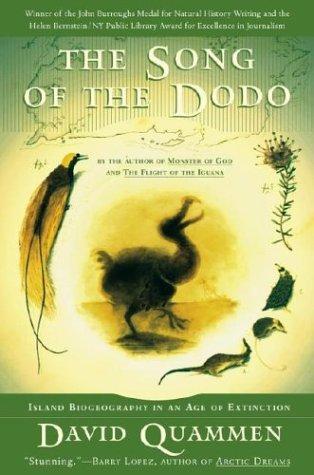
Talk to The Song of the Dodo: Island Biogeography in an Age of Extinction like its author wrote you back.
Get the ideas that fit your life — not generic summaries.
- Chat with the book
- Audiobook-style main ideas
- Adapts to your life and goals
- Helps you take action
What it argues
The Song of the Dodo is David Quammen's magnum opus on island biogeography — the science of how species are distributed across isolated habitats and why islands, both literal and metaphorical, are where extinction concentrates. At more than 700 pages, it is an ambitious work of science journalism that traces a scientific field from Darwin and Alfred Russel Wallace to E.O. Wilson and Robert MacArthur, while also traveling to Komodo, Mauritius, the Aru Islands, and Bali to show what the theory looks like on the ground.
The central insight of island biogeography, developed by Wilson and MacArthur in the 1960s, is that the number of species an island can support is determined by its area and its distance from a source of new colonists. Larger islands support more species; smaller ones support fewer. When a large habitat is fragmented — by roads, agriculture, or deforestation — what remains are habitat islands surrounded by a hostile matrix. The theory predicts that species will begin going extinct even in protected reserves, because protected reserves are effectively small islands. The consequences for conservation are uncomfortable: most existing reserves are too small, too isolated, and too fragmented to prevent extinctions indefinitely.
What it gets right
- 1.
Island biogeography holds that species richness on an island is determined by area and isolation: larger, closer islands support more species than smaller, more distant ones.
- 2.
When habitat is fragmented, the fragments function as islands. Species begin disappearing even when the habitat itself is formally protected, because the fragments are too small.
- 3.
The theory predicts a relaxation effect: species counts in a fragment will decline over time toward the equilibrium number the fragment's size can support, even without further habitat loss.
What it covers
Who wrote it
David Quammen is an American science journalist and author based in Montana. He is a contributing writer for National Geographic and has written more than fifteen books, including The Tangled Tree, Spillover, and Monster of God. The Song of the Dodo, published in 1996, won the John Burroughs Medal and is widely regarded as one of the best works of science journalism of the twentieth century. His writing combines field reporting with intellectual history and reaches readers without a science background through narrative rather than lectures.
