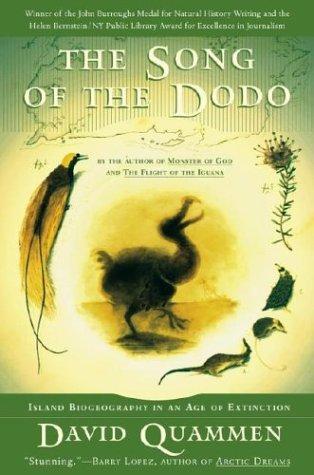
The Song of the Dodo: Island Biogeography in an Age of Extinction by David Quammen is a 1996 science book about extinction, island biogeography, evolution. Island biogeography holds that species richness on an island is determined by area and isolation: larger, closer islands support more species than smaller, more distant ones.
Summary
The Song of the Dodo is David Quammen's magnum opus on island biogeography — the science of how species are distributed across isolated habitats and why islands, both literal and metaphorical, are where extinction concentrates. At more than 700 pages, it is an ambitious work of science journalism that traces a scientific field from Darwin and Alfred Russel Wallace to E.O. Wilson and Robert MacArthur, while also traveling to Komodo, Mauritius, the Aru Islands, and Bali to show what the theory looks like on the ground.
The central insight of island biogeography, developed by Wilson and MacArthur in the 1960s, is that the number of species an island can support is determined by its area and its distance from a source of new colonists. Larger islands support more species; smaller ones support fewer. When a large habitat is fragmented — by roads, agriculture, or deforestation — what remains are habitat islands surrounded by a hostile matrix. The theory predicts that species will begin going extinct even in protected reserves, because protected reserves are effectively small islands. The consequences for conservation are uncomfortable: most existing reserves are too small, too isolated, and too fragmented to prevent extinctions indefinitely.
Quammen is a meticulous reporter and an elegant writer. The scientific explanations are interwoven with travel narrative and biography. He spends time with herpetologists, ornithologists, and conservation biologists and lets their field work illustrate the abstract theory. The chapters on Mauritius and the extinction of the dodo — a flightless bird killed off within decades of European contact — ground the book in the visceral reality of what biodiversity loss means.
The book was published in 1996 and is occasionally dated in its scientific references, but its central argument has only grown more urgent. Habitat fragmentation is accelerating, not slowing. Quammen's case that we are living through a mass extinction event driven not by single catastrophic events but by the quiet arithmetic of shrinking islands is more relevant now than when the book was written.
Talk to The Song of the Dodo: Island Biogeography in an Age of Extinction like its author wrote you back.
Get the ideas that fit your life — not generic summaries.
- Chat with the book
- Audiobook-style main ideas
- Adapts to your life and goals
- Helps you take action
Key takeaways
- 1.
Island biogeography holds that species richness on an island is determined by area and isolation: larger, closer islands support more species than smaller, more distant ones.
- 2.
When habitat is fragmented, the fragments function as islands. Species begin disappearing even when the habitat itself is formally protected, because the fragments are too small.
- 3.
The theory predicts a relaxation effect: species counts in a fragment will decline over time toward the equilibrium number the fragment's size can support, even without further habitat loss.
- 4.
Most existing nature reserves are too small to prevent long-term extinction of the species they nominally protect; conservation biology needs network thinking, not just reserve thinking.
- 5.
The dodo's extinction within decades of European contact is a template: naive species on islands evolve without predators and are therefore catastrophically vulnerable to humans and introduced animals.
- 6.
Alfred Russel Wallace independently developed the theory of natural selection at roughly the same time as Darwin, but history has largely assigned credit to Darwin.
- 7.
Minimum viable population theory tries to calculate the smallest population of a species that has a reasonable probability of persisting — the answer is usually larger than existing reserves accommodate.
- 8.
The sixth mass extinction is not a future scenario but an ongoing process driven by habitat fragmentation, invasive species, hunting, and climate change, all compounding each other.
Discussion questions
Use these on your own, with a book club, or as chat starters in Superbook. Book club version, ready to copy or print →
- 1.
Quammen argues that habitat fragments are biologically equivalent to islands. Does that metaphor help you understand conservation differently, or does it feel like a stretch?
- 2.
The dodo became an emblem of human-caused extinction. What other lost species do you think should carry similar weight in public consciousness, and why don't they?
- 3.
Island biogeography predicts extinctions even in protected areas. Does that finding suggest the current conservation strategy is fundamentally broken, or just incomplete?
- 4.
Wallace and Darwin developed the same theory independently. If Darwin had been a different person — less connected, less prolific — would the theory of natural selection have been delayed significantly, or would someone else have published it first?
- 5.
Quammen traveled extensively for this book, spending time with field biologists across multiple continents. Does that kind of immersive science journalism produce better or worse understanding than purely desk-based research?
- 6.
The book was published in 1996. Which parts of its argument feel most dated, and which feel more relevant now than they did when written?
- 7.
How should societies weigh economic development against biodiversity protection when the evidence suggests that most of our reserves are already too small to work?
- 8.
Quammen describes species going extinct in reserves where they are nominally protected. Who is morally responsible for those extinctions?
- 9.
The book is extremely long for a science trade book. Does that length serve the argument, or does it suggest the case could be made more efficiently?
- 10.
If you had to choose one policy change — one concrete thing governments or individuals could do — based on what this book argues, what would it be?
- 11.
The title refers to the dodo, which of course can no longer sing. What does that image communicate about what is lost in extinction beyond biodiversity statistics?
- 12.
Quammen profiles E.O. Wilson, one of the architects of island biogeography theory. What do you think Wilson's legacy in conservation biology looks like from today's vantage point?
Themes
Frequently asked questions
-
What is island biogeography?
Island biogeography is the study of how species are distributed across islands and other isolated habitats. Its core finding is that species richness is predicted by island area and distance from a colonization source. The theory has major implications for conservation because habitat fragments function like islands.
-
Is The Song of the Dodo worth reading in 2026?
Yes, despite its age. The core theory is still foundational in conservation biology, and the writing is exceptional. Some species data is dated but the central argument about fragmentation and extinction has only become more urgent. It is long, but rewarding throughout.
-
How long does it take to read The Song of the Dodo?
Around twelve to thirteen hours. At over 700 pages it is Quammen's longest and most ambitious book. It rewards patience — the travel narrative and biographical chapters make the dense theory digestible, but it is not a quick read.
-
Who is the book primarily about?
No single person. Quammen traces a lineage of scientists from Darwin and Wallace to E.O. Wilson and MacArthur, weaving in field reports from current researchers. The dodo and Mauritius serve as the emotional anchor, but the intellectual center is Wilson and MacArthur's theory.
-
Do I need a biology background to read this?
No. Quammen explains population biology and ecological theory as he goes. The book is aimed at curious general readers, not specialists. The main demand it makes is time.