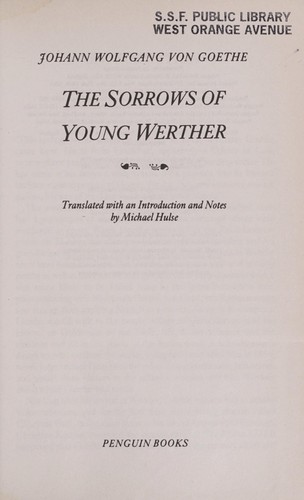
Talk to The Sorrows of Young Werther like its author wrote you back.
Get the ideas that fit your life — not generic summaries.
- Chat with the book
- Audiobook-style main ideas
- Adapts to your life and goals
- Helps you take action
The Sorrows of Young Werther, in detail
The Sorrows of Young Werther is an epistolary novel — told almost entirely in letters from the protagonist to his friend Wilhelm — about a young man of artistic sensibility who falls devastatingly in love with a woman already promised to another. Published in 1774, when Goethe was twenty-four, it became one of the most explosive literary debuts in European history, inspiring something historians would later call "Werther fever": a wave of romanticized suicides across the continent.
What the novel is actually about is harder to name than "tragic romance." Werther's love for Lotte is real and rendered with remarkable precision, but the deeper subject is a particular kind of consciousness — one that experiences everything with unbearable intensity, that cannot separate aesthetic rapture from emotional suffering, that turns nature, art, and eventually another human being into a mirror for its own inner weather. Werther doesn't just love Lotte; he constructs her as the center of a worldview that can have no peaceful resolution. The novel is a clinical portrait of Romantic pathology wrapped inside genuine feeling.
Goethe's style is luminous and intimate. The first half, full of the joy of fresh infatuation and walks through flowering meadows, reads with a warmth that makes the second half's descent more painful. The letters form an unreliable portrait — we only ever have Werther's perspective, and the novel quietly asks whether the object of his devotion ever really corresponded to his vision of her. The editor's note that closes the book, switching abruptly to third person to describe the suicide, is one of the more chilling formal moves in eighteenth-century literature.
Readers who find Werther insufferable will not be wrong — he is overdramatic, self-absorbed, and ultimately refuses every exit the world offers him. But that's the point. The novel is less interested in whether Werther is right than in what it looks like from the inside to be this kind of person: the costs of feeling everything too much, the ways idealism becomes a trap, and what happens when a person's inner world collides violently with the social structures of the real one.
The big ideas
- 1.
Werther's suffering is partly caused by love and partly self-created — his idealism transforms a real woman into a symbol he cannot possess without destroying.
- 2.
The epistolary form creates a closed loop: we only have Werther's version of events, which raises the question of how much distortion is baked into the narration.
- 3.
Goethe captures the specific texture of early Romantic feeling: the way nature, art, and human emotion blur together into a single overwhelming current.
