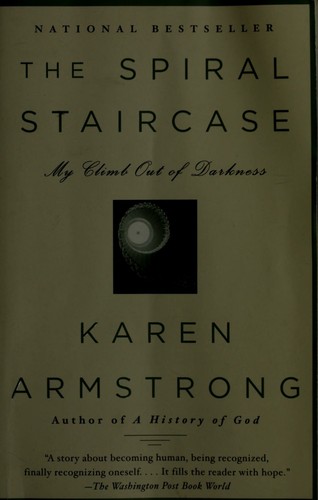
Talk to The Spiral Staircase: My Climb Out of Darkness like its author wrote you back.
Get the ideas that fit your life — not generic summaries.
- Chat with the book
- Audiobook-style main ideas
- Adapts to your life and goals
- Helps you take action
What it argues
The Spiral Staircase is Karen Armstrong's account of the years between leaving her convent in 1969 and discovering the religious scholarship that would define her later career. It is a memoir about failure, illness, and an unexpected route back to something like faith — not the institutional Catholicism she left behind, but a hard-won personal understanding of what religion at its best is actually for.
Armstrong left the convent after seven years because the religious life had not produced what she hoped: the direct experience of God she had expected in exchange for obedience and sacrifice. She emerged disoriented, academically behind, and suffering from episodes she would eventually understand as undiagnosed epilepsy — episodes that she had been told were signs of spiritual deficiency. The first part of the book covers her years at Oxford, where she struggled to complete her literature degree, felt increasingly out of step with secular academic culture, and experienced depression and episodes of strange dissociation that no one around her understood.
What it gets right
- 1.
Armstrong's seven years in the convent were defined by obedience and self-suppression rather than genuine spiritual development — a cautionary story about the difference between religious institution and religious experience.
- 2.
Her undiagnosed temporal lobe epilepsy produced episodes she and others interpreted as spiritual failure or lack of grace, showing how medical misunderstanding shaped her religious self-perception for years.
- 3.
Leaving a total institution like a convent leaves lasting marks on the personality — underdeveloped social skills, difficulty with intimacy, and a sense of being permanently out of sync with secular life.
What it covers
Who wrote it
Karen Armstrong is a British author and former Roman Catholic nun who left her convent in 1969 after seven years. She subsequently became one of the world's leading commentators on religion, writing more than twenty books on subjects ranging from early Christianity and Islam to the Buddha and the Hebrew Bible. Her other major works include A History of God, The Case for God, The Battle for God, Muhammad, and Fields of Blood. She founded the Charter for Compassion in 2008 and has received honorary doctorates from universities in multiple countries.
