The Spiral Staircase: My Climb Out of Darkness by Karen Armstrong is a 2004 memoir book about faith and doubt, mental illness, religious vocation. Armstrong's seven years in the convent were defined by obedience and self-suppression rather than genuine spiritual development — a cautionary story about the difference between religious institution and religious experience.
Summary
The Spiral Staircase is Karen Armstrong's account of the years between leaving her convent in 1969 and discovering the religious scholarship that would define her later career. It is a memoir about failure, illness, and an unexpected route back to something like faith — not the institutional Catholicism she left behind, but a hard-won personal understanding of what religion at its best is actually for.
Armstrong left the convent after seven years because the religious life had not produced what she hoped: the direct experience of God she had expected in exchange for obedience and sacrifice. She emerged disoriented, academically behind, and suffering from episodes she would eventually understand as undiagnosed epilepsy — episodes that she had been told were signs of spiritual deficiency. The first part of the book covers her years at Oxford, where she struggled to complete her literature degree, felt increasingly out of step with secular academic culture, and experienced depression and episodes of strange dissociation that no one around her understood.
The middle section covers a difficult career as a documentary filmmaker and teacher, marked by loneliness and a growing sense that she had failed both as a nun and as a secular person. Armstrong is honest about her bitterness toward the convent and toward the Church, and about the ways the religious training had left her emotionally underdeveloped for ordinary life.
The turn comes when she is commissioned to make a documentary about St. Paul and is forced to read seriously in religious scholarship for the first time. She discovers a tradition of religious thought vastly richer and more intellectually serious than anything she encountered in the convent. Writing about comparative religion becomes, unexpectedly, what prayer had never been: a genuine encounter with something larger than herself. The book's title alludes to T.S. Eliot's description of the spiritual journey as a spiral staircase — not a straight ascent but a return to the same place with slightly altered vision.
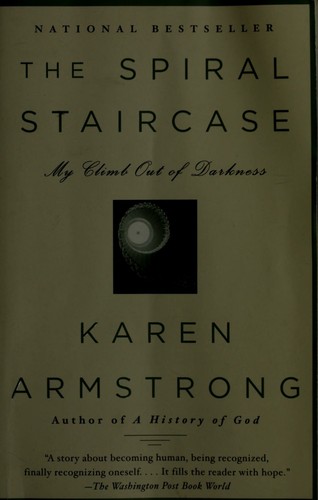
Talk to The Spiral Staircase: My Climb Out of Darkness like its author wrote you back.
Get the ideas that fit your life — not generic summaries.
- Chat with the book
- Audiobook-style main ideas
- Adapts to your life and goals
- Helps you take action
Key takeaways
- 1.
Armstrong's seven years in the convent were defined by obedience and self-suppression rather than genuine spiritual development — a cautionary story about the difference between religious institution and religious experience.
- 2.
Her undiagnosed temporal lobe epilepsy produced episodes she and others interpreted as spiritual failure or lack of grace, showing how medical misunderstanding shaped her religious self-perception for years.
- 3.
Leaving a total institution like a convent leaves lasting marks on the personality — underdeveloped social skills, difficulty with intimacy, and a sense of being permanently out of sync with secular life.
- 4.
Armstrong found her way back to religion not through prayer or practice but through scholarship — a route she considers valid and that others might recognize as an intellectual form of the religious quest.
- 5.
Compassion, she comes to believe, is the core of every religious tradition, not doctrine or correct belief. This conclusion emerges from reading rather than from convent formation.
- 6.
The spiral staircase metaphor captures the experience of progress that doesn't look like progress: returning to familiar questions with slightly different eyes rather than ascending in a straight line.
- 7.
Her trajectory from failed nun to one of the world's most read commentators on religion suggests that failure at a particular vocation doesn't preclude finding a genuine one.
- 8.
Armstrong's memoir is unusual in combining a story of psychological recovery with an intellectual history of how her ideas about religion developed.
Discussion questions
Use these on your own, with a book club, or as chat starters in Superbook. Book club version, ready to copy or print →
- 1.
Armstrong expected the religious life to give her direct experience of God and was disappointed. What assumptions about religious practice does that expectation reveal?
- 2.
Her epilepsy went undiagnosed partly because the convent interpreted her symptoms spiritually. What does that say about the hazards of interpreting all experience through a single interpretive frame?
- 3.
She describes the convent as damaging to her emotional development in ways she needed years to undo. Does the evidence in the memoir support that judgment, or does she oversimplify?
- 4.
Armstrong found her vocation through scholarship rather than practice. Is intellectual engagement with religious questions a form of religious life, or something different?
- 5.
She comes to believe compassion is religion's core. Does this seem like an insight earned by her experience, or a conclusion she was already inclined toward?
- 6.
The spiral staircase metaphor suggests we revisit the same questions rather than leaving them behind. Does that describe your own experience of important questions in your life?
- 7.
Armstrong is candid about her failures — academic, professional, personal. Does her honesty strengthen the memoir's authority, or does it sometimes feel like self-flagellation?
- 8.
How do you understand the difference between the institutional religion Armstrong left and the private religious life she eventually found? Is that distinction sustainable long-term?
- 9.
Many readers encounter this book as a story about recovery from a bad institution. Do you read it primarily as a spiritual memoir, a psychological memoir, or something else?
- 10.
Armstrong writes with considerable anger toward the Church for her early years. Does that anger seem justified, excessive, or complicated by her later appreciation for religious thought?
- 11.
She describes secular academic life as feeling almost as alienating as convent life. What does that suggest about where she finally found belonging?
- 12.
The book was written after Armstrong had become famous for A History of God. Does knowing how the story ends change how you read the suffering in the middle?
Themes
Frequently asked questions
-
What is The Spiral Staircase about?
It is Karen Armstrong's memoir of the years after she left the convent in 1969, covering her struggles with undiagnosed epilepsy, academic and professional failure, and her unexpected return to religion through scholarship rather than practice.
-
Do I need to read Armstrong's other books first?
No. The Spiral Staircase works as a standalone memoir and is a useful entry point for readers unfamiliar with Armstrong, since it explains the biographical roots of her later religious thinking.
-
Is this book religious or secular in its outlook?
Both. Armstrong is deeply sympathetic to religious experience and religious thought, but she is no longer a practicing Catholic and is skeptical of institutional religion. The book ends with a personal, non-dogmatic sense of what religion is for.
-
How does The Spiral Staircase compare to Armstrong's other writing?
It is more personal and more emotionally direct than her historical and theological works. Readers who find her scholarship dense may find the memoir more accessible and more revealing about the motivations behind her ideas.
-
Who should read this book?
Readers interested in religion and doubt, in stories of leaving religious life, or in how intellectual vocation develops from personal crisis. It also works well alongside memoirs by others who left high-control religious environments.