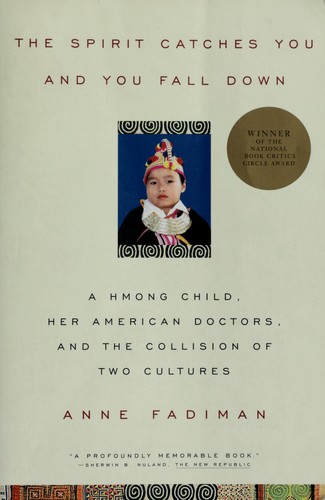
Talk to The Spirit Catches You and You Fall Down like its author wrote you back.
Get the ideas that fit your life — not generic summaries.
- Chat with the book
- Audiobook-style main ideas
- Adapts to your life and goals
- Helps you take action
What it argues
Anne Fadiman's account of Lia Lee, a Hmong child in Merced, California who suffered from severe epilepsy, and the catastrophic failure of understanding between her family and the American medical system that treated her, is one of the most important works of narrative nonfiction about medicine, immigration, and cultural translation. Published in 1997 after seven years of reporting, it won the National Book Critics Circle Award and became essential reading in medical schools across the United States.
Lia was born in 1982 to Hmong refugee parents who had fled Laos after the end of the Vietnam War. In Hmong belief, her epileptic seizures were understood as quag dab peg — "the spirit catches you and you fall down" — a condition caused by soul loss that conferred spiritual power as well as illness. Her parents believed she was potentially a txiv neeb, a shaman. The physicians at Merced Community Medical Center understood her condition as a neurological disorder requiring precise medication management. These two understandings were not simply in tension; they were incommensurable, and the collision between them ended in tragedy.
What it gets right
- 1.
Cultural competence is not optional in medicine. The Lee case demonstrates that technical medical skill is insufficient when the patient's explanatory model of illness is fundamentally different from the physician's.
- 2.
Blame is inadequate as a response to systemic failure. The book resists assigning fault to the Lees or to the doctors and instead points to the absence of infrastructure for cultural translation.
- 3.
Medical compliance requires trust, and trust requires communication. Patients who cannot understand their physicians, or who have no reason to trust the medical system, will manage their own treatment according to their own frameworks.
What it covers
Who wrote it
Anne Fadiman is an American essayist and journalist who served as editor of The American Scholar and has taught literary nonfiction at Yale and other universities. She is the daughter of the writer and editor Clifton Fadiman. The Spirit Catches You and You Fall Down, her first book, was researched over seven years and won the National Book Critics Circle Award for General Nonfiction in 1997. Her essay collection Ex Libris: Confessions of a Common Reader is widely read in literary circles. She is known for meticulous research and a prose style that makes complex subjects approachable without simplifying them.
