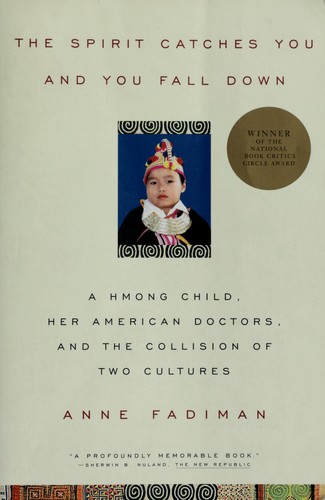
The Spirit Catches You and You Fall Down by Anne Fadiman is a 1997 memoir book about culture clash, medicine, immigration. Cultural competence is not optional in medicine. The Lee case demonstrates that technical medical skill is insufficient when the patient's explanatory model of illness is fundamentally different from the physician's.
Summary
Anne Fadiman's account of Lia Lee, a Hmong child in Merced, California who suffered from severe epilepsy, and the catastrophic failure of understanding between her family and the American medical system that treated her, is one of the most important works of narrative nonfiction about medicine, immigration, and cultural translation. Published in 1997 after seven years of reporting, it won the National Book Critics Circle Award and became essential reading in medical schools across the United States.
Lia was born in 1982 to Hmong refugee parents who had fled Laos after the end of the Vietnam War. In Hmong belief, her epileptic seizures were understood as quag dab peg — "the spirit catches you and you fall down" — a condition caused by soul loss that conferred spiritual power as well as illness. Her parents believed she was potentially a txiv neeb, a shaman. The physicians at Merced Community Medical Center understood her condition as a neurological disorder requiring precise medication management. These two understandings were not simply in tension; they were incommensurable, and the collision between them ended in tragedy.
Fadiman structures the book to generate equal sympathy for both sides. The Lees are attentive, loving parents who were also inconsistent with medication protocols in ways that contributed to Lia's catastrophic brain damage at age four. The doctors, especially Neil Ernst and Peggy Philp, were skilled and genuinely committed to Lia's welfare and also culturally inflexible in ways that made compliance nearly impossible. The medical system had no Hmong interpreters and no infrastructure for cultural mediation. Everyone failed, and nobody was simply wrong.
The book also includes a rich history of the Hmong people — their mountain culture in Laos, their role as CIA allies during the Vietnam War, their catastrophic displacement and resettlement in California's Central Valley. This history is not background; it is the argument. Understanding why the Lees responded as they did requires understanding what they had survived and what their cultural framework was designed to make survivable.
Talk to The Spirit Catches You and You Fall Down like its author wrote you back.
Get the ideas that fit your life — not generic summaries.
- Chat with the book
- Audiobook-style main ideas
- Adapts to your life and goals
- Helps you take action
Key takeaways
- 1.
Cultural competence is not optional in medicine. The Lee case demonstrates that technical medical skill is insufficient when the patient's explanatory model of illness is fundamentally different from the physician's.
- 2.
Blame is inadequate as a response to systemic failure. The book resists assigning fault to the Lees or to the doctors and instead points to the absence of infrastructure for cultural translation.
- 3.
Medical compliance requires trust, and trust requires communication. Patients who cannot understand their physicians, or who have no reason to trust the medical system, will manage their own treatment according to their own frameworks.
- 4.
The Hmong experience of American medicine reflects a broader question about whose knowledge is authoritative. The book does not privilege Western medicine over Hmong healing traditions; it asks what happens when they cannot coexist.
- 5.
Refugee trauma shapes how communities respond to new environments. The Hmong's history of displacement and loss is inseparable from their resistance to American institutional authority.
- 6.
Language barriers in medicine are not merely inconvenient — they are life-threatening. The absence of adequate interpretation is a systemic failure with measurable consequences.
- 7.
Love and harm are not mutually exclusive. The Lees loved Lia profoundly and their management of her illness contributed to her brain damage. The doctors loved medicine and their rigidity contributed to the outcome too.
- 8.
Narrative nonfiction can do things statistics cannot. Fadiman's book changed medical education not through data but through a single case rendered in full human complexity.
Discussion questions
Use these on your own, with a book club, or as chat starters in Superbook. Book club version, ready to copy or print →
- 1.
Fadiman goes to considerable lengths to generate sympathy for both the Lees and the doctors. Does the book succeed in this? Do you find yourself distributing blame despite the author's intentions?
- 2.
The concept of 'cultural competence' in medicine has grown considerably since this book was published. Has it solved the problems the book identifies?
- 3.
What does the book suggest is owed to immigrant communities by the medical system? Is that obligation primarily ethical, legal, or practical?
- 4.
The Hmong explanatory model of Lia's illness — soul loss, potential shamanic calling — is given serious attention by Fadiman. Should it have been given more weight by the medical team?
- 5.
The book includes a full history of the Hmong people. Is that historical context necessary for understanding the medical story, or does it sometimes feel like a separate book?
- 6.
Lia's parents were noncompliant with medication protocols. Under what conditions, if any, should medical teams override parental authority for a child's care?
- 7.
The outcome was a catastrophe. What specific changes — in policy, in training, in system design — might have prevented it?
- 8.
Fadiman spent years with both the Lee family and the medical team. What are the ethics of a journalist maintaining relationships with all parties in a contested situation?
- 9.
The book ends with Lia still alive but profoundly brain-damaged, cared for at home by her parents with evident devotion. How do you read that ending?
- 10.
What does this case suggest about the limits of Western medicine's self-understanding as value-neutral and scientific?
- 11.
The book was published in 1997. Has the American healthcare system's approach to cultural and linguistic diversity improved since then?
Themes
Frequently asked questions
-
Is The Spirit Catches You and You Fall Down required reading in medical schools?
Yes, at many medical schools across the United States. It became a standard text in medical humanities curricula after its publication, and is often cited by physicians as the book that most changed how they thought about the patient-physician relationship.
-
What happened to Lia Lee after the book was published?
Lia remained in a persistent vegetative state, cared for at home by her family. She died in 2012 at the age of thirty. Her mother Foua died the following year. Fadiman continued to stay in contact with the Lee family and wrote about Lia's death.
-
Is the book neutral between the Lees and the doctors?
Fadiman explicitly tries to give both sides equal sympathy, and most readers feel she succeeds. Some medical professionals have argued that the book is harder on the doctors; some Hmong advocates have argued the reverse. The controversy suggests she found something close to the center.
-
Do I need medical knowledge to read it?
No. Fadiman explains all medical concepts clearly. The book is intended for general readers, not specialists. The medical sections are among the most accessible in the book.
-
Is the title literal?
Yes. 'Quag dab peg' — the Hmong name for epilepsy — translates literally as 'the spirit catches you and you fall down.' Fadiman uses it as a metaphor for the entire collision between systems of understanding the book describes.
Similar books
Being Mortal: Medicine and What Matters in the End
Atul Gawande
Mountains Beyond Mountains
Tracy Kidder
The Emperor of All Maladies: A Biography of Cancer
Siddhartha Mukherjee
