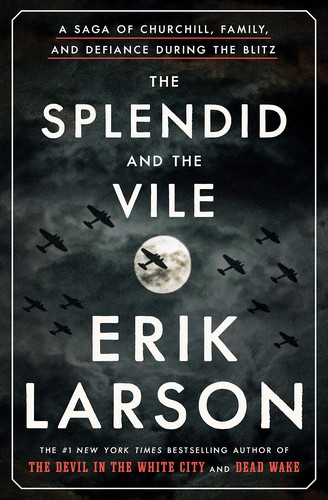
Talk to The Splendid and the Vile: A Saga of Churchill, Family, and Defiance During the Blitz like its author wrote you back.
Get the ideas that fit your life — not generic summaries.
- Chat with the book
- Audiobook-style main ideas
- Adapts to your life and goals
- Helps you take action
The Splendid and the Vile: A Saga of Churchill, Family, and Defiance During the Blitz, in detail
Erik Larson's The Splendid and the Vile covers Winston Churchill's first year as British Prime Minister — from May 1940, when he replaced Neville Chamberlain three days after Germany's invasion of the Low Countries, through May 1941. That year encompassed Dunkirk, the Battle of Britain, the Blitz, the sinking of the Bismarck, and the sustained effort to bring the United States into the war. Larson tells it through diaries, letters, and contemporary accounts — not as a conventional political biography but as a day-by-day narrative of how Churchill, his family, his inner circle, and ordinary Londoners experienced the most sustained aerial assault on a major city in history.
Larson's method is to interweave the grand political narrative with the intimate domestic one. We see Churchill dictating speeches in the bath, his daughter Mary's wartime diary entries, his son-in-law Vic Oliver's fraught relationship with his wife Sarah, the parallel lives of Churchill's scientific adviser Frederick Lindemann and private secretary John Colville. The German side is represented through the diary of Joseph Goebbels and the strategic thinking of Hermann Göring. The effect is to keep the enormous violence and high politics anchored in the texture of daily life: the smell of bombed buildings, the exhaustion of shelter workers, the social complexities of a government under siege.
The leadership portrait that emerges is not hagiographic but it is admiring. Larson shows Churchill managing morale with deliberate craft — choosing words for maximum resonance, timing appearances in bombed neighborhoods, maintaining a public energy that concealed private anxiety. His famous speeches are presented not as spontaneous inspiration but as products of careful drafting, revision, and strategic calculation about what the public and international audiences needed to hear. He was also frequently demanding, indulgent with subordinates he liked, and willing to take enormous personal risks that alarmed his security detail.
What gives the book its unusual texture is Larson's discipline. He relies entirely on contemporary sources — diaries, letters, operational records — and refuses to speculate about what people were thinking when no document records it. This gives the narrative an immediacy that more interpretive histories lack. The bombing campaigns, the near-misses, the grief and gallows humor of Londoners under fire, come through with unusual clarity. It is not a book about strategy or politics in the conventional sense; it is a book about how people behave when everything is at stake.
The big ideas
- 1.
Churchill understood that morale was a strategic resource and managed it deliberately — his appearances, speeches, and emotional displays were crafted for maximum effect on both domestic and international audiences.
- 2.
The Blitz killed around 45,000 British civilians and destroyed large sections of London and other cities, but failed to break civilian morale or force a British surrender, partly because of how public response was shaped.
- 3.
Churchill's relationship with Roosevelt was cultivated over the entire first year with extraordinary patience — he understood that American public opinion had to be moved before American policy could change.
