The Splendid and the Vile: A Saga of Churchill, Family, and Defiance During the Blitz by Erik Larson is a 2020 history book about world war ii, leadership, resilience. Churchill understood that morale was a strategic resource and managed it deliberately — his appearances, speeches, and emotional displays were crafted for maximum effect on both domestic and international audiences.
Summary
Erik Larson's The Splendid and the Vile covers Winston Churchill's first year as British Prime Minister — from May 1940, when he replaced Neville Chamberlain three days after Germany's invasion of the Low Countries, through May 1941. That year encompassed Dunkirk, the Battle of Britain, the Blitz, the sinking of the Bismarck, and the sustained effort to bring the United States into the war. Larson tells it through diaries, letters, and contemporary accounts — not as a conventional political biography but as a day-by-day narrative of how Churchill, his family, his inner circle, and ordinary Londoners experienced the most sustained aerial assault on a major city in history.
Larson's method is to interweave the grand political narrative with the intimate domestic one. We see Churchill dictating speeches in the bath, his daughter Mary's wartime diary entries, his son-in-law Vic Oliver's fraught relationship with his wife Sarah, the parallel lives of Churchill's scientific adviser Frederick Lindemann and private secretary John Colville. The German side is represented through the diary of Joseph Goebbels and the strategic thinking of Hermann Göring. The effect is to keep the enormous violence and high politics anchored in the texture of daily life: the smell of bombed buildings, the exhaustion of shelter workers, the social complexities of a government under siege.
The leadership portrait that emerges is not hagiographic but it is admiring. Larson shows Churchill managing morale with deliberate craft — choosing words for maximum resonance, timing appearances in bombed neighborhoods, maintaining a public energy that concealed private anxiety. His famous speeches are presented not as spontaneous inspiration but as products of careful drafting, revision, and strategic calculation about what the public and international audiences needed to hear. He was also frequently demanding, indulgent with subordinates he liked, and willing to take enormous personal risks that alarmed his security detail.
What gives the book its unusual texture is Larson's discipline. He relies entirely on contemporary sources — diaries, letters, operational records — and refuses to speculate about what people were thinking when no document records it. This gives the narrative an immediacy that more interpretive histories lack. The bombing campaigns, the near-misses, the grief and gallows humor of Londoners under fire, come through with unusual clarity. It is not a book about strategy or politics in the conventional sense; it is a book about how people behave when everything is at stake.
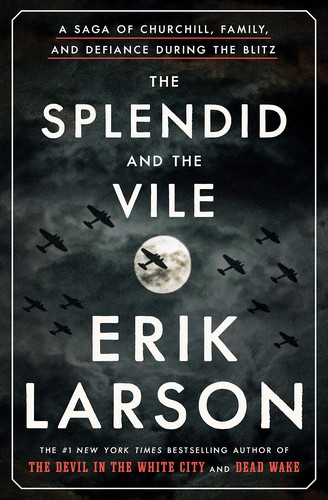
Talk to The Splendid and the Vile: A Saga of Churchill, Family, and Defiance During the Blitz like its author wrote you back.
Get the ideas that fit your life — not generic summaries.
- Chat with the book
- Audiobook-style main ideas
- Adapts to your life and goals
- Helps you take action
Key takeaways
- 1.
Churchill understood that morale was a strategic resource and managed it deliberately — his appearances, speeches, and emotional displays were crafted for maximum effect on both domestic and international audiences.
- 2.
The Blitz killed around 45,000 British civilians and destroyed large sections of London and other cities, but failed to break civilian morale or force a British surrender, partly because of how public response was shaped.
- 3.
Churchill's relationship with Roosevelt was cultivated over the entire first year with extraordinary patience — he understood that American public opinion had to be moved before American policy could change.
- 4.
The men and women closest to Churchill — Colville, Lindemann, the family members — reveal him as simultaneously inspiring and exhausting, generous and demanding.
- 5.
The German strategic decision to shift from bombing RAF airfields to bombing cities in September 1940 was a critical error that gave Britain time to recover its air defenses.
- 6.
Larson's method of relying entirely on contemporary documents produces a portrait of the period that resists retrospective distortion — the outcome was not foreordained, and contemporary sources reflect genuine uncertainty about survival.
- 7.
Daily life under sustained bombing created both community and trauma. The social solidarity it produced was real, but so was the psychological damage that went largely unacknowledged at the time.
- 8.
The war's intersection with the personal — marriages strained, children evacuated, ordinary ambitions suspended — gives the grand historical narrative a human scale that military histories often miss.
Discussion questions
Use these on your own, with a book club, or as chat starters in Superbook. Book club version, ready to copy or print →
- 1.
Larson focuses on Churchill's first year as Prime Minister. Does concentrating on a single year make the leadership portrait more or less convincing?
- 2.
Churchill managed morale as a deliberate strategy. Is that admirable political leadership or manipulation? Where is the line?
- 3.
The book interweaves the public Churchill with the private one — the family, the staff, the daily routines. Did that approach change how you thought about his public role?
- 4.
How does Larson's method — relying only on contemporary documents — affect the texture and reliability of the narrative?
- 5.
The German shift from bombing airfields to bombing cities in September 1940 may have saved Britain. How should we think about history's dependence on such contingent errors?
- 6.
The civilian experience of the Blitz involved genuine solidarity but also fear, exhaustion, and psychological damage that was suppressed at the time. How does official memory of the Blitz compare to the reality Larson describes?
- 7.
Churchill's relationship with Roosevelt was a sustained courtship. What does it reveal about how alliance politics actually works, compared to how it is usually taught?
- 8.
The book covers a genuinely heroic moment in British history. Does knowing what came after — the end of empire, Britain's reduced postwar role — change how you read it?
- 9.
Which secondary figure — Colville, Lindemann, Mary Churchill, Göring, Goebbels — did you find most illuminating, and why?
- 10.
Larson is known for narrative nonfiction that reads like a thriller. Did that approach serve this subject, or did it sometimes feel like the entertainment value overrode the historical seriousness?
- 11.
The Blitz is central to British national identity. Does reading this book complicate or reinforce that identity?
- 12.
What specific detail from the book stuck with you most, and what does it reveal about the period?
Themes
Frequently asked questions
-
Is The Splendid and the Vile worth reading?
Yes, particularly if you want an intimate account of how the Blitz was actually experienced rather than a strategic or political history. Larson's archival method produces an immediacy that conventional Churchill biographies cannot match, and the pace is consistently absorbing.
-
How long does it take to read The Splendid and the Vile?
About nine to ten hours at average reading pace for the roughly 560-page book. The chapters are short and the narrative moves quickly. Many readers finish it over a weekend.
-
Do I need to know much about World War II to read this book?
A basic familiarity helps — knowing who Chamberlain was, what Dunkirk means, why the US staying out of the war mattered — but Larson provides enough context that readers without detailed prior knowledge can follow the narrative without difficulty.
-
How does this compare to a conventional Churchill biography?
It covers only one year and does not try to assess Churchill's whole career or place him in broader historical perspective. It is better at texture and immediacy than analysis. Readers wanting a full reckoning with Churchill's record should read it alongside a more comprehensive biography.
-
What makes Larson's approach distinctive?
He uses only sources that existed at the time — diaries, letters, contemporary documents — and refuses to retrospectively impose knowledge of outcomes on people who didn't have it. That discipline gives the narrative genuine suspense and keeps the reader in the uncertain present of 1940 to 1941.
Similar books
The Devil in the White City
Erik Larson
Killers of the Flower Moon
David Grann
Unbroken: A World War II Story of Survival, Resilience, and Redemption
Laura Hillenbrand
The Rise and Fall of the Third Reich
William L. Shirer
