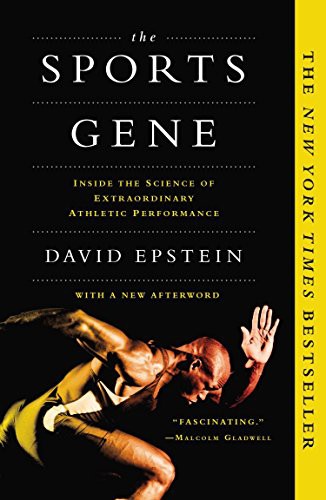
Talk to The Sports Gene like its author wrote you back.
Get the ideas that fit your life — not generic summaries.
- Chat with the book
- Audiobook-style main ideas
- Adapts to your life and goals
- Helps you take action
What it argues
The Sports Gene is David Epstein's investigation into the science of athletic performance — specifically the question of how much genetics determines who becomes elite. Written as a counterpoint to Malcolm Gladwell's 10,000-hours rule (which Epstein largely disputes), the book argues that talent is real, that the genetic underpinnings of athletic ability are well-documented and varied, and that the relationship between practice and performance is far more complex than popular accounts of deliberate practice suggest.
Epstein is a Science and Sports Illustrated journalist, and the book is primarily reporting rather than advocacy. He interviews geneticists, sports scientists, coaches, and athletes, and examines specific case studies: the gene variants associated with elite endurance performance in East African runners, the ACTN3 gene that affects muscle fiber type distribution, the cardiovascular anatomy of outlier athletes like NBA players who have unusual heart dimensions, and the visual processing speed that distinguishes elite hitters in baseball.
What it gets right
- 1.
The 10,000-hours rule, as popularly understood, is overstated: practice alone cannot account for elite athletic performance, and genetic factors play a substantial and measurable role.
- 2.
Specific gene variants — ACTN3, ACE, EPOR, and many others — affect muscle composition, cardiovascular capacity, and recovery in ways that directly influence athletic potential.
- 3.
Trainability varies genetically: some people respond to identical training with dramatically more adaptation than others, meaning the relationship between practice and performance is not uniform.
What it covers
Who wrote it
David Epstein is an American author and investigative journalist, formerly a senior writer at Sports Illustrated and ProPublica. He holds a master's degree in environmental science from Columbia University and has written extensively about sports science, genetics, and medicine. His other book, Range: Why Generalists Triumph in a Specialized World, examines a similar tension between early specialization and broad development. The Sports Gene, published in 2013, was a finalist for the PEN/E.O. Wilson Literary Science Writing Award. Epstein lives in Washington, D.C.
