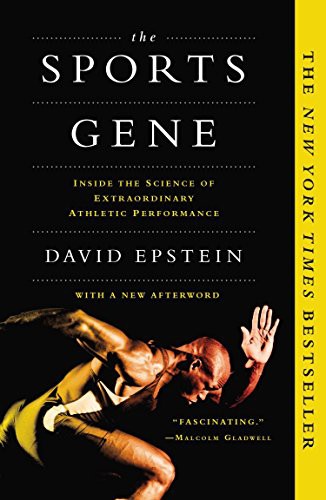
The Sports Gene by David Epstein is a 2013 science book about athletic genetics, human performance, nature vs nurture. The 10,000-hours rule, as popularly understood, is overstated: practice alone cannot account for elite athletic performance, and genetic factors play a substantial and measurable role.
Summary
The Sports Gene is David Epstein's investigation into the science of athletic performance — specifically the question of how much genetics determines who becomes elite. Written as a counterpoint to Malcolm Gladwell's 10,000-hours rule (which Epstein largely disputes), the book argues that talent is real, that the genetic underpinnings of athletic ability are well-documented and varied, and that the relationship between practice and performance is far more complex than popular accounts of deliberate practice suggest.
Epstein is a Science and Sports Illustrated journalist, and the book is primarily reporting rather than advocacy. He interviews geneticists, sports scientists, coaches, and athletes, and examines specific case studies: the gene variants associated with elite endurance performance in East African runners, the ACTN3 gene that affects muscle fiber type distribution, the cardiovascular anatomy of outlier athletes like NBA players who have unusual heart dimensions, and the visual processing speed that distinguishes elite hitters in baseball.
The core argument is that the genetic contribution to athletic performance is substantial and specific — not a general "athletic talent" but particular physiological traits that interact with specific sporting demands. A West African genetic background that increases the proportion of fast-twitch muscle fibers is advantageous for sprinting; East African runners from the Rift Valley have anatomical features — long, slender limbs and high aerobic efficiency — that translate directly to elite marathon performance. These are not explanations that eliminate training or diminish achievement, but they do mean that genetic luck is a major determinant of who reaches the top.
Epstein is careful not to reduce performance to genetics: the book also covers how training interacts with genetics, how some people respond to identical training with dramatically different results ("trainability"), and how environmental factors like altitude and childhood physical activity interact with genetic potential. The picture that emerges is complicated — neither pure genetic determinism nor pure deliberate practice adequately explains elite performance. What the book achieves is a more accurate and nuanced account of what it actually takes to become world-class at anything requiring physical performance.
Talk to The Sports Gene like its author wrote you back.
Get the ideas that fit your life — not generic summaries.
- Chat with the book
- Audiobook-style main ideas
- Adapts to your life and goals
- Helps you take action
Key takeaways
- 1.
The 10,000-hours rule, as popularly understood, is overstated: practice alone cannot account for elite athletic performance, and genetic factors play a substantial and measurable role.
- 2.
Specific gene variants — ACTN3, ACE, EPOR, and many others — affect muscle composition, cardiovascular capacity, and recovery in ways that directly influence athletic potential.
- 3.
Trainability varies genetically: some people respond to identical training with dramatically more adaptation than others, meaning the relationship between practice and performance is not uniform.
- 4.
East African running dominance has measurable anatomical correlates — limb proportions, aerobic efficiency, and altitude adaptation — that are at least partially genetic and interact with training.
- 5.
Visual processing speed and pattern recognition in elite hitters and batters exceed normal human averages in ways that appear to have genetic as well as experiential components.
- 6.
High-performance athletes often have unusual anatomical features — wingspan, heart chamber size, tendon insertion points — that would be disadvantages in ordinary life but advantages in their specific sport.
- 7.
Genetic testing for athletic potential is scientifically premature: the variants identified so far explain a small fraction of performance variance, and most traits are polygenic and interact with environment.
- 8.
The nature-nurture dichotomy is false for athletic performance: genetics sets the potential and training determines how much of it is realized, but both are necessary.
Discussion questions
Use these on your own, with a book club, or as chat starters in Superbook. Book club version, ready to copy or print →
- 1.
Epstein disputes the 10,000-hours rule's implication that anyone can become elite with enough deliberate practice. Does that reframing feel like realism or an excuse to give up on difficult goals?
- 2.
The book documents genetic clustering in specific sports — West Africans in sprinting, East Africans in distance running. How should sports and coaching communities think about genetic advantage without sliding into racial essentialism?
- 3.
He covers the variability in how people respond to identical training. Have you observed in yourself or others that some people respond dramatically better to the same exercise program? What did you attribute that to?
- 4.
Some parents have begun genetic testing children for sports potential. Does that seem like useful information or a problematic shortcut?
- 5.
Epstein covers the ethical issues around genetic testing in sport — for potential, for doping detection, for injury risk. Where are the appropriate limits?
- 6.
The book argues that genetic luck is a major determinant of elite performance. How does that change how you think about celebrating or emulating athletic greatness?
- 7.
He covers cases like Eero Mäntyranta, the Finnish cross-country skier who had a genetic mutation giving him dramatically elevated red blood cell counts. Is that natural doping? Where is the line between genetic advantage and unfair advantage?
- 8.
If you could know your own genetic athletic profile with current testing, would you want to? What would you do with that information?
- 9.
Epstein covers the role of early childhood physical activity and sport sampling in developing athletic potential. How does the current model of youth sport specialization compare to what the science suggests?
- 10.
The book describes athletes with unusual anatomical features — extreme wingspan, rare heart morphology — that are advantages in their sport. Does that change your awe of elite performance?
- 11.
Epstein finds that elite athletes in many sports have specific advantages that are not about raw athleticism but about sport-specific physical traits. What does that suggest about the breadth of athletic potential across different physical profiles?
- 12.
How does knowing the genetic component of athletic performance affect what you think parents should tell children about their athletic potential?
Themes
Frequently asked questions
-
Does The Sports Gene argue that talent is purely genetic?
No. Epstein argues that genetics plays a larger and more specific role in athletic performance than popular accounts of deliberate practice suggest, but he is careful to show how training interacts with genetic potential. The book is a correction to the extreme nurture position, not an endorsement of genetic determinism.
-
Does The Sports Gene claim that race explains performance differences in athletics?
Epstein addresses this directly and carefully. He identifies specific genetic variants associated with performance differences and traces their geographic origins, but is explicit that these are not racial categories — the relevant genetic variation exists within, not between, traditional racial groupings, and the patterns he describes relate to specific ancestral populations, not racial taxonomies.
-
Is The Sports Gene relevant to recreational athletes?
Yes, particularly for understanding variability in training response. Knowing that people differ genetically in how much they adapt to the same training explains why identical programs produce very different results in different people — a practically useful insight regardless of whether you're chasing elite performance.
-
What is the ACTN3 gene and why does it matter in The Sports Gene?
ACTN3 encodes alpha-actinin-3, a protein found in fast-twitch muscle fibers. A common variant eliminates the protein entirely. Elite sprinters are almost never ACTN3 deficient, while elite endurance athletes are more commonly so — suggesting that fast-twitch muscle composition contributes to sprinting but may be disadvantageous for endurance.
-
How does The Sports Gene relate to Range by the same author?
The Sports Gene examines genetic constraints on athletic potential and the complexity of talent development in sport. Range examines a broader question about whether early specialization or broad sampling of skills produces better performance across domains. Both books push back against simple rule-based accounts of excellence.
Similar books
Born to Run
Christopher McDougall
Range: Why Generalists Triumph in a Specialized World
David Epstein

Grit: The Power of Passion and Perseverance
Angela Duckworth

The Story of the Human Body
Daniel Lieberman
