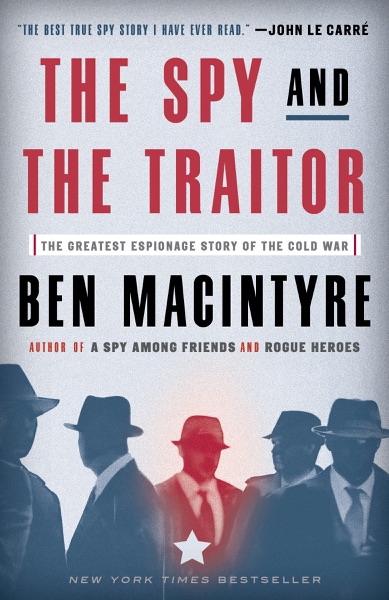
Talk to The Spy and the Traitor: The Greatest Espionage Story of the Cold War like its author wrote you back.
Get the ideas that fit your life — not generic summaries.
- Chat with the book
- Audiobook-style main ideas
- Adapts to your life and goals
- Helps you take action
The Spy and the Traitor: The Greatest Espionage Story of the Cold War, in detail
Ben Macintyre tells the story of Oleg Gordievsky, a KGB officer who became the most important British spy of the Cold War. Gordievsky rose to become the KGB's London station chief while simultaneously feeding intelligence to MI6 for more than a decade. His defection-in-place and eventual dramatic escape from the Soviet Union in 1985 is, in Macintyre's telling, among the most consequential and suspenseful episodes in the history of intelligence.
Macintyre traces Gordievsky's radicalization against the Soviet system, which began with the crushing of the Prague Spring in 1968 and deepened through years of watching KGB brutality and Soviet ideology up close. The book avoids the cliché of the ideologically passionate convert: Gordievsky's motives are layered, mixing genuine anti-communism with personal pride, a love of British culture, and the particular psychology of the double life. His relationship with his MI6 handlers comes through as genuinely warm and collaborative in a way that most spy narratives don't manage.
The intelligence Gordievsky provided shaped some of the most critical moments of Cold War tension. His reports helped convince Western leaders that the Soviets genuinely believed, in the early 1980s, that NATO was preparing a first nuclear strike — a paranoid miscalculation that brought the two sides dangerously close to accidental war. He also identified hundreds of Soviet intelligence assets operating in the West. The stakes are not abstract.
The escape sequence is extraordinary. After being betrayed by Aldrich Ames within the CIA and called back to Moscow for interrogation, Gordievsky managed to activate a prearranged escape signal and was smuggled out of the Soviet Union hidden in the boot of a British diplomat's car. Macintyre is a meticulous researcher and a fluid storyteller, and the combination produces a narrative that reads at times like a thriller while remaining scrupulously documented.
The big ideas
- 1.
Gordievsky's decade as a British mole inside the KGB produced intelligence that directly influenced Cold War policy and reduced the risk of nuclear miscalculation.
- 2.
The ABLE ARCHER 83 nuclear war scare — when the Soviets genuinely feared a Western first strike — was only defused in part because Gordievsky told Western leaders how serious Soviet paranoia had become.
- 3.
Aldrich Ames's betrayal of Gordievsky within the CIA is one of the most damaging leaks in American intelligence history, compromising dozens of Western assets.
