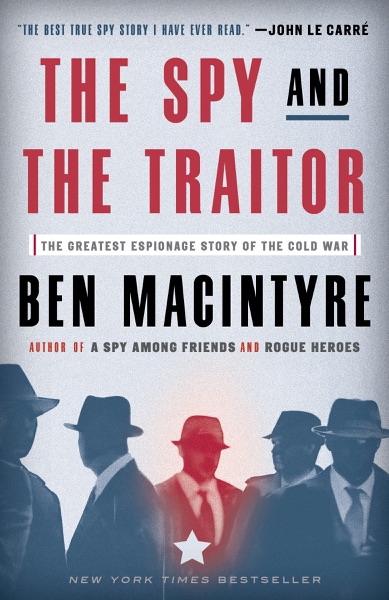
The Spy and the Traitor: The Greatest Espionage Story of the Cold War by Ben Macintyre is a 2018 history book about espionage, cold war, loyalty. Gordievsky's decade as a British mole inside the KGB produced intelligence that directly influenced Cold War policy and reduced the risk of nuclear miscalculation.
Summary
Ben Macintyre tells the story of Oleg Gordievsky, a KGB officer who became the most important British spy of the Cold War. Gordievsky rose to become the KGB's London station chief while simultaneously feeding intelligence to MI6 for more than a decade. His defection-in-place and eventual dramatic escape from the Soviet Union in 1985 is, in Macintyre's telling, among the most consequential and suspenseful episodes in the history of intelligence.
Macintyre traces Gordievsky's radicalization against the Soviet system, which began with the crushing of the Prague Spring in 1968 and deepened through years of watching KGB brutality and Soviet ideology up close. The book avoids the cliché of the ideologically passionate convert: Gordievsky's motives are layered, mixing genuine anti-communism with personal pride, a love of British culture, and the particular psychology of the double life. His relationship with his MI6 handlers comes through as genuinely warm and collaborative in a way that most spy narratives don't manage.
The intelligence Gordievsky provided shaped some of the most critical moments of Cold War tension. His reports helped convince Western leaders that the Soviets genuinely believed, in the early 1980s, that NATO was preparing a first nuclear strike — a paranoid miscalculation that brought the two sides dangerously close to accidental war. He also identified hundreds of Soviet intelligence assets operating in the West. The stakes are not abstract.
The escape sequence is extraordinary. After being betrayed by Aldrich Ames within the CIA and called back to Moscow for interrogation, Gordievsky managed to activate a prearranged escape signal and was smuggled out of the Soviet Union hidden in the boot of a British diplomat's car. Macintyre is a meticulous researcher and a fluid storyteller, and the combination produces a narrative that reads at times like a thriller while remaining scrupulously documented.
Talk to The Spy and the Traitor: The Greatest Espionage Story of the Cold War like its author wrote you back.
Get the ideas that fit your life — not generic summaries.
- Chat with the book
- Audiobook-style main ideas
- Adapts to your life and goals
- Helps you take action
Key takeaways
- 1.
Gordievsky's decade as a British mole inside the KGB produced intelligence that directly influenced Cold War policy and reduced the risk of nuclear miscalculation.
- 2.
The ABLE ARCHER 83 nuclear war scare — when the Soviets genuinely feared a Western first strike — was only defused in part because Gordievsky told Western leaders how serious Soviet paranoia had become.
- 3.
Aldrich Ames's betrayal of Gordievsky within the CIA is one of the most damaging leaks in American intelligence history, compromising dozens of Western assets.
- 4.
Double agents rarely operate from a single, clean motive. Gordievsky's mix of ideological conviction, personal pride, and attachment to British culture reflects a more complicated psychological truth.
- 5.
The escape plan — codenamed PIMLICO — was rehearsed for years and activated by Gordievsky leaving a shopping bag on a street corner, a signal MI6 monitored for over a decade.
- 6.
Intelligence services are only as secure as their weakest link. Gordievsky's exposure came not from any failure of tradecraft on his part but from a mole inside the CIA.
- 7.
The human cost of Cold War espionage extended to Gordievsky's family: his wife and daughters were kept behind in the Soviet Union for years after his escape.
- 8.
Macintyre shows how the KGB's ideological rigidity made it systematically poor at interpreting intelligence that contradicted the party line.
Discussion questions
Use these on your own, with a book club, or as chat starters in Superbook. Book club version, ready to copy or print →
- 1.
Gordievsky risked his life for years for an intelligence service that could not fully protect him. What do you think kept him going during the long years of no escape plan and no acknowledgment?
- 2.
Macintyre argues Gordievsky's motives were mixed rather than purely ideological. Does that make him more or less sympathetic to you as a subject?
- 3.
The ABLE ARCHER crisis showed that intelligence failures can push nuclear powers toward war without either side intending it. What does that suggest about how international crises should be managed?
- 4.
Gordievsky's wife did not know he was a spy and initially stayed loyal to the Soviet system after his defection. How do you read her position in the story?
- 5.
Aldrich Ames's betrayal sacrificed Gordievsky and others for money. What does the Ames case suggest about the structural vulnerabilities in intelligence sharing between allies?
- 6.
Macintyre depicts the relationship between Gordievsky and his MI6 handlers as genuinely warm. Does that surprise you, given the professional nature of the relationship?
- 7.
The escape plan required years of preparation and a tiny window. What does that level of operational patience say about how intelligence services work compared to the popular image?
- 8.
Gordievsky spent years watching KGB colleagues punish and destroy people for dissent. How do you think that daily exposure shaped his willingness to take risk?
- 9.
The KGB called Gordievsky a traitor; the British called him a hero. How does Macintyre navigate that tension, and do you find his framing convincing?
- 10.
If Gordievsky had been caught, his intelligence record would largely have been buried. What does that say about how history is shaped by survival and luck?
- 11.
Does reading this book change how you think about the morality of espionage — particularly the use of individuals as assets in a larger geopolitical conflict?
- 12.
What does this story suggest about how authoritarian systems rot from within over time?
Themes
Frequently asked questions
-
Is The Spy and the Traitor a true story?
Yes. Oleg Gordievsky is a real person who worked for MI6 while serving as a KGB officer and was smuggled out of the Soviet Union in 1985. Macintyre interviewed Gordievsky extensively and worked from declassified intelligence documents and firsthand accounts.
-
How long does it take to read The Spy and the Traitor?
Around six hours at average reading pace. The book is 390 pages and written to move quickly — chapters are tightly paced and the narrative builds toward the escape sequence with sustained momentum.
-
What is the most important intelligence Gordievsky provided?
His reporting on Operation RYAN, the Soviet program monitoring for signs of a Western nuclear first strike, and his account of the ABLE ARCHER 83 war scare convinced Western leaders that Soviet paranoia about imminent attack was real — information that may have prevented an accidental war.
-
Who should read The Spy and the Traitor?
Readers interested in Cold War history, espionage, or narrative nonfiction. It works equally well as a fast-paced human drama and as a serious account of how intelligence shapes geopolitical events. Prior knowledge of the Cold War is helpful but not required.
-
How does this book compare to Macintyre's other espionage histories?
Many readers regard it as his best. The Gordievsky case combines longer-term stakes, a more complex central character, and a more consequential intelligence impact than the WWII cases in Operation Mincemeat or Agent Zigzag. The escape sequence is among the most gripping passages in any of his books.
Similar books
The Anatomy of Fascism
Robert O. Paxton
The Rise and Fall of the Third Reich
William L. Shirer
American Prometheus
Kai Bird and Martin J. Sherwin
Sapiens: A Brief History of Humankind
Yuval Noah Harari
