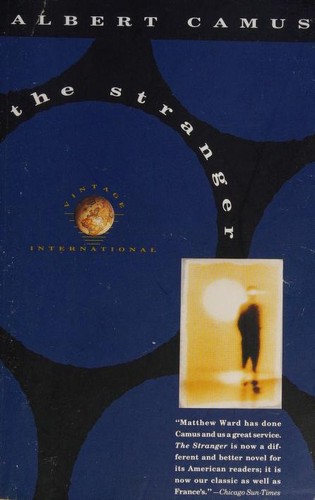
Talk to The Stranger like its author wrote you back.
Get the ideas that fit your life — not generic summaries.
- Chat with the book
- Audiobook-style main ideas
- Adapts to your life and goals
- Helps you take action
What it argues
Meursault is a French Algerian clerk who, over a few days following his mother's funeral, takes a girlfriend, shoots an Arab man on a beach for no clearly articulable reason, and is tried and sentenced to death. The trial, however, is not really about the killing: it is about Meursault's failure to cry at his mother's funeral, his emotional detachment, his refusal to perform the feelings that society considers appropriate. Camus wrote this in 1942 as his first major novel and as a kind of story version of his philosophical essay The Myth of Sisyphus, which appeared the same year.
The novel is an exercise in a specific kind of honesty that society finds intolerable. Meursault notices what he notices — the heat, the light, the texture of physical experience — and does not feel or express what he is supposed to feel about death, love, or God. This is not psychopathy: it is a refusal to perform emotions he doesn't have, and the court (and the novel's original readers) find that refusal more damning than the crime itself. Camus is arguing that this radical honesty is, in a sense, heroic — the absurd hero's refusal to pretend meaning exists where it doesn't.
What it gets right
- 1.
Meursault is condemned less for killing a man than for failing to perform grief at his mother's funeral. The trial is a trial of emotional authenticity, not of violent crime.
- 2.
The absurd, for Camus, is not nihilism. It is the confrontation between human desire for meaning and the universe's silence — and the honest acknowledgment of that gap rather than escape from it.
- 3.
The flat, declarative prose style is not neutral. It enacts Meursault's consciousness: the sun and a dead body receive equal grammatical weight because that is how he actually perceives the world.
What it covers
Who wrote it
Albert Camus (1913–1960) was a French-Algerian author, philosopher, and journalist who won the Nobel Prize in Literature in 1957. His major works include The Stranger (1942), The Plague (1947), The Fall (1956), and the philosophical essay The Myth of Sisyphus (1942). Camus developed the philosophy of the absurd — the confrontation between human desire for meaning and the universe's silence — and was associated with French existentialism, though he resisted the label. He died in a car accident at 46.
