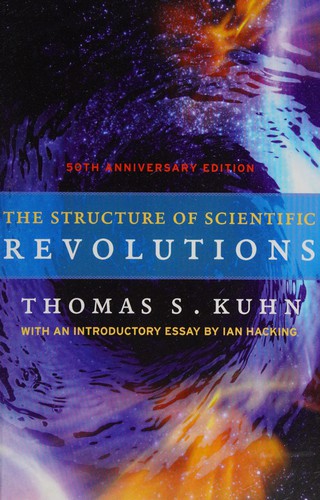
Talk to The Structure of Scientific Revolutions like its author wrote you back.
Get the ideas that fit your life — not generic summaries.
- Chat with the book
- Audiobook-style main ideas
- Adapts to your life and goals
- Helps you take action
What it argues
The Structure of Scientific Revolutions, first published in 1962, changed how historians, philosophers, and scientists think about how science advances. Thomas Kuhn, a physicist-turned-historian of science, argued against the prevailing picture of science as a steady accumulation of facts and laws. Science, he showed, actually moves through long periods of stability punctuated by sudden, disruptive transformations — what he called paradigm shifts.
Kuhn's central concept is the paradigm: the set of shared assumptions, methods, exemplary problems, and standards that define a mature scientific community's approach to its subject. Under normal science, researchers work within a paradigm, solving puzzles that the framework poses. Anomalies — observations that don't fit — are initially set aside, explained away, or assigned to future resolution. Only when anomalies accumulate to crisis proportions does the community begin to entertain a new framework. The shift from Newtonian mechanics to Einstein's relativity is his most cited example; the Copernican revolution and the chemical revolution from phlogiston to oxygen are others.
What it gets right
- 1.
Science does not progress through steady accumulation of facts but through long stable periods of 'normal science' punctuated by sudden revolutionary paradigm shifts.
- 2.
A paradigm is a shared framework of assumptions, methods, and exemplary solved problems that defines what questions a scientific community asks and what counts as a valid answer.
- 3.
Normal science involves puzzle-solving within the accepted paradigm; anomalies are initially set aside rather than taken as refutations of the framework.
What it covers
Who wrote it
Thomas S. Kuhn (1922–1996) was an American historian and philosopher of science. He received his doctorate in physics from Harvard and later turned to the history of science, teaching at Berkeley, Princeton, and MIT. The Structure of Scientific Revolutions, published as a monograph in the International Encyclopedia of Unified Science, became one of the most-cited academic works of the twentieth century. His other books include The Copernican Revolution and Black-Body Theory and the Quantum Discontinuity. The term "paradigm shift" entered popular language largely through his influence, often in ways he found imprecise.
