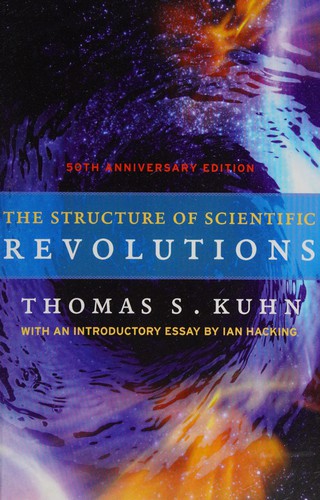
The Structure of Scientific Revolutions by Thomas S. Kuhn is a 1962 science book about paradigm shifts, scientific progress, philosophy of science. Science does not progress through steady accumulation of facts but through long stable periods of 'normal science' punctuated by sudden revolutionary paradigm shifts.
Summary
The Structure of Scientific Revolutions, first published in 1962, changed how historians, philosophers, and scientists think about how science advances. Thomas Kuhn, a physicist-turned-historian of science, argued against the prevailing picture of science as a steady accumulation of facts and laws. Science, he showed, actually moves through long periods of stability punctuated by sudden, disruptive transformations — what he called paradigm shifts.
Kuhn's central concept is the paradigm: the set of shared assumptions, methods, exemplary problems, and standards that define a mature scientific community's approach to its subject. Under normal science, researchers work within a paradigm, solving puzzles that the framework poses. Anomalies — observations that don't fit — are initially set aside, explained away, or assigned to future resolution. Only when anomalies accumulate to crisis proportions does the community begin to entertain a new framework. The shift from Newtonian mechanics to Einstein's relativity is his most cited example; the Copernican revolution and the chemical revolution from phlogiston to oxygen are others.
What made the book controversial — and what has kept it in print for six decades — is Kuhn's argument about what happens during a paradigm shift. Scientists working in different paradigms, he argued, are not simply debating the facts; they are partly speaking different languages, using the same terms to mean different things, and evaluating evidence by different standards. This concept of incommensurability — the idea that competing paradigms cannot be directly compared on neutral ground — was read by critics as relativism and by admirers as an important truth about the limits of scientific objectivity.
Kuhn insisted he was not arguing that science is irrational or that all theories are equally good. He was arguing that the process of theory change in science cannot be fully explained by logic and evidence alone: it involves social dynamics, the generational turnover of practitioners, and an element of collective judgment that is not reducible to algorithm. The result is a portrait of science that is more honest about its human dimensions without surrendering the idea that science makes progress.
Talk to The Structure of Scientific Revolutions like its author wrote you back.
Get the ideas that fit your life — not generic summaries.
- Chat with the book
- Audiobook-style main ideas
- Adapts to your life and goals
- Helps you take action
Key takeaways
- 1.
Science does not progress through steady accumulation of facts but through long stable periods of 'normal science' punctuated by sudden revolutionary paradigm shifts.
- 2.
A paradigm is a shared framework of assumptions, methods, and exemplary solved problems that defines what questions a scientific community asks and what counts as a valid answer.
- 3.
Normal science involves puzzle-solving within the accepted paradigm; anomalies are initially set aside rather than taken as refutations of the framework.
- 4.
Crisis occurs when anomalies accumulate to the point where the community can no longer contain them, prompting a search for an alternative framework.
- 5.
Paradigm shifts are not driven by logic and evidence alone; they involve social persuasion, generational change, and a kind of collective conversion experience.
- 6.
Competing paradigms are 'incommensurable' — scientists working in different paradigms partly talk past each other because their basic concepts mean different things.
- 7.
The Copernican revolution, Lavoisier's chemical revolution, and Einstein's relativity are all examples of paradigm shifts: the new framework doesn't simply add to the old one but replaces its foundations.
- 8.
Kuhn's argument does not imply relativism about science — he believed science makes genuine progress — but it does challenge the view that scientific progress is purely rational and cumulative.
Discussion questions
Use these on your own, with a book club, or as chat starters in Superbook. Book club version, ready to copy or print →
- 1.
Kuhn distinguishes normal science from revolutionary science. Can you think of a field you know well where this distinction applies?
- 2.
He argues anomalies are initially ignored or explained away rather than treated as refutations. Is that a flaw in scientific practice or a reasonable feature of how communities manage uncertainty?
- 3.
What's an example of a paradigm shift from outside natural science — in medicine, economics, social science, or your own field — that fits Kuhn's pattern?
- 4.
The incommensurability thesis says scientists in different paradigms partly speak different languages. Does that explain anything about current scientific debates — for instance, over nutrition, economics, or AI?
- 5.
Kuhn's book was widely read as relativist even though he insisted it wasn't. Why do you think that reading took hold, and is there something in the text that invites it?
- 6.
He argues paradigm shifts are partly social processes. Does that make you more or less confident in scientific consensus, or does it depend on the field?
- 7.
Normal science solves puzzles within a framework without questioning the framework itself. Is that conservative approach valuable, or does it slow progress?
- 8.
Max Planck famously said science advances one funeral at a time, because old scientists don't change their minds — they just die. Is Kuhn's account compatible with that cynicism?
- 9.
Which of the historical examples — Copernican revolution, oxygen discovery, relativity — did you find most illuminating as an illustration of the theory?
- 10.
Kuhn's concept of paradigm has spread far beyond science into management, politics, and popular culture. Is that a useful generalization or a dilution of a precise idea?
- 11.
If you were a scientist in 1962 reading this book, would you find it threatening or liberating?
- 12.
What would it take for a paradigm shift to happen in a field that currently seems to have strong consensus — climate science, vaccine safety, or cosmology?
Themes
Frequently asked questions
-
What is a paradigm shift in simple terms?
A paradigm shift is Kuhn's term for a fundamental change in the basic framework scientists use to understand a field — not just a new discovery but a replacement of the underlying assumptions, methods, and concepts. The shift from thinking the sun orbits the Earth to knowing the Earth orbits the sun is the canonical example.
-
Is The Structure of Scientific Revolutions hard to read?
It is academic but accessible. Kuhn writes clearly and uses concrete historical examples throughout. The most challenging sections involve the incommensurability thesis. Most general readers can follow the argument without specialized philosophy training.
-
Is Kuhn arguing that science is just a matter of opinion?
No. Kuhn argued that theory choice during revolutions is underdetermined by logic and evidence alone, not that all theories are equally valid. He believed science makes genuine progress toward better explanations of nature. The relativist reading of his work is a persistent misunderstanding he addressed in later editions.
-
Why is this book still assigned in science courses?
Because it forces students to think about science as a human practice with social and historical dimensions, not just a method for finding facts. Understanding how paradigms work helps researchers recognize when anomalies are significant and when consensus might be vulnerable to challenge.
-
What is the most important idea in the book?
Probably the insight that scientific communities are held together not by logic alone but by shared exemplars — solved problems that demonstrate what good work looks like. This explains why normal science is conservative and why revolutions feel like conversions rather than deductions.