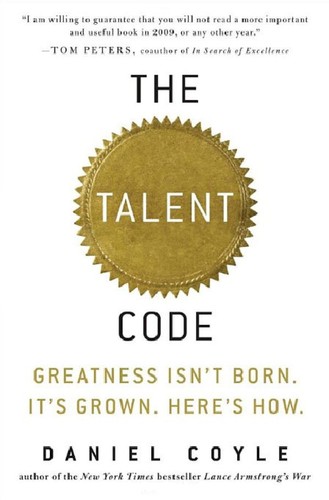
Talk to The Talent Code like its author wrote you back.
Get the ideas that fit your life — not generic summaries.
- Chat with the book
- Audiobook-style main ideas
- Adapts to your life and goals
- Helps you take action
What it argues
The Talent Code is Daniel Coyle's investigation into why certain places — a tennis academy in Russia, a soccer training ground in Brazil, a music conservatory in Texas — produce a disproportionate number of world-class performers. His answer centers on three interconnected ideas: deep practice, ignition, and master coaching — and on the biological mechanism that underlies them all: myelin.
Myelin is the insulating sheath that wraps neural circuits. Every time a skill circuit fires accurately, myelin thickens, speeding and strengthening the signal. This is the biological basis for skill: practice doesn't just build habits, it literally builds brain tissue. Coyle argues that the right kind of practice — what he and others call deep practice — fires myelin-building circuits more efficiently than conventional repetition. Deep practice operates at the edge of ability, is slow and error-prone at first, and involves noticing and correcting mistakes in detail.
What it gets right
- 1.
Myelin — the insulating sheath wrapping neural circuits — is the biological substrate of skill. Accurate practice builds myelin, speeding and strengthening neural signals. You are literally building brain tissue when you practice correctly.
- 2.
Deep practice operates at the edge of ability: slow, error-prone, with careful attention to mistakes. This is more myelin-efficient than confident repetition of things you already know.
- 3.
Struggle is not a sign that practice is going wrong. The moment of reaching for a skill just beyond your grasp is when myelin grows fastest.
What it covers
Who wrote it
Daniel Coyle is an American journalist and author who spent years visiting talent hotbeds around the world to research The Talent Code. He is also the author of The Culture Code, The Little Book of Talent, and Lance Armstrong's War. He has written for Sports Illustrated, Outside, and The New York Times Magazine. The Talent Code, published in 2009, was a New York Times bestseller and is widely used in coaching, education, and sports training programs.
