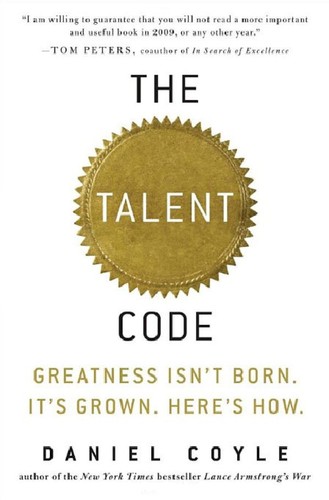
The Talent Code by Daniel Coyle is a 2009 science book about talent, skill acquisition, deliberate practice. Myelin — the insulating sheath wrapping neural circuits — is the biological substrate of skill. Accurate practice builds myelin, speeding and strengthening neural signals. You are literally building brain tissue when you practice correctly.
Summary
The Talent Code is Daniel Coyle's investigation into why certain places — a tennis academy in Russia, a soccer training ground in Brazil, a music conservatory in Texas — produce a disproportionate number of world-class performers. His answer centers on three interconnected ideas: deep practice, ignition, and master coaching — and on the biological mechanism that underlies them all: myelin.
Myelin is the insulating sheath that wraps neural circuits. Every time a skill circuit fires accurately, myelin thickens, speeding and strengthening the signal. This is the biological basis for skill: practice doesn't just build habits, it literally builds brain tissue. Coyle argues that the right kind of practice — what he and others call deep practice — fires myelin-building circuits more efficiently than conventional repetition. Deep practice operates at the edge of ability, is slow and error-prone at first, and involves noticing and correcting mistakes in detail.
The second mechanism is ignition: the motivational spark that sustains long-term practice. Coyle's research into talent hotbeds consistently finds a triggering event — a role model, a moment of recognition, a cultural narrative — that creates a powerful sense of identity connection to the skill. This is not a romantic account of passion; ignition is often triggered by fairly ordinary events seen through the right lens.
The third element is the master coach: the person who diagnoses current ability accurately, provides precise targeted feedback, and creates conditions for productive struggle. Coyle profiles several master coaches and finds that the best are often quiet, observant, and sparing with praise — the opposite of the motivational-speaker archetype. The Talent Code is well-reported journalism that translates neuroscience into a surprisingly practical account of how skill develops.
Talk to The Talent Code like its author wrote you back.
Get the ideas that fit your life — not generic summaries.
- Chat with the book
- Audiobook-style main ideas
- Adapts to your life and goals
- Helps you take action
Key takeaways
- 1.
Myelin — the insulating sheath wrapping neural circuits — is the biological substrate of skill. Accurate practice builds myelin, speeding and strengthening neural signals. You are literally building brain tissue when you practice correctly.
- 2.
Deep practice operates at the edge of ability: slow, error-prone, with careful attention to mistakes. This is more myelin-efficient than confident repetition of things you already know.
- 3.
Struggle is not a sign that practice is going wrong. The moment of reaching for a skill just beyond your grasp is when myelin grows fastest.
- 4.
Ignition — the motivational spark that sustains long-term practice — is often triggered by identity connection to a skill, not by natural passion. It can be engineered.
- 5.
Master coaches are not motivational speakers. The best are observant, precise, and sparing with feedback — they diagnose accurately and provide targeted corrections.
- 6.
Talent hotbeds cluster in specific places for a reason: cultural narrative, role models, and training structures that create both ignition and deep practice conditions.
- 7.
Chunking — breaking complex skills into small, repeatable units and practicing them slowly before integrating them — is how master performers build their repertoires.
- 8.
Most conventional practice is too fast, too confident, and too far from the error-correction that builds myelin. The uncomfortable, slow, mistake-filled practice is the valuable kind.
Discussion questions
Use these on your own, with a book club, or as chat starters in Superbook. Book club version, ready to copy or print →
- 1.
Coyle's myelin explanation grounds skill development in neuroscience. Does having a biological mechanism for practice change how you think about effort and improvement?
- 2.
Think of a skill you practice regularly. How much of that practice involves working at the edge of your ability versus repeating what you already know?
- 3.
What is a talent hotbed you've witnessed personally — a school, a team, a community that produced an unusual number of high performers? What conditions made it distinctive?
- 4.
Ignition often comes from a role model or a moment of identity connection. Can you identify the ignition event for your most developed skill? What triggered it?
- 5.
Coyle's master coaches are often quiet and precise rather than enthusiastic and encouraging. Does that match the best teachers or coaches you've had?
- 6.
What does deep practice look like in your most important skill domain? What would you need to change to practice more at the edge rather than in the comfort zone?
- 7.
He argues that struggle is the signal of learning, not failure. How do you distinguish productive struggle from unproductive confusion in your own practice?
- 8.
The Brazilian soccer street culture that Coyle describes isn't formal training — it's just the specific game conditions that happen to create deep practice. What informal conditions in your life produce the most skill growth?
- 9.
Coyle describes coaches who give very little feedback, very precisely chosen. Think of the feedback you receive on your most important work. Is it too much, too little, or not specific enough?
- 10.
The talent code concept suggests that almost anyone can become genuinely skilled at almost anything with the right practice and motivation. Do you believe that? What limits it?
- 11.
What is a skill you've always considered to be innate in others but might actually be learned? What would investigating that assumption reveal?
- 12.
Coyle identifies myelin decay as part of normal aging, and notes that sustained practice slows it. Does this change how you think about staying sharp in later life?
Themes
Frequently asked questions
-
Is The Talent Code worth reading?
Yes, particularly if you work in education, coaching, or any field involving skill development. The myelin research is genuinely illuminating and the talent hotbed reporting is compelling. It covers similar territory to Peak by Ericsson but from a journalistic rather than scientific angle, making it more accessible.
-
How long does it take to read The Talent Code?
About four hours. The reporting is narrative-driven and reads quickly. The book is structured in three sections — deep practice, ignition, master coaching — each of which can be read independently.
-
What is the main idea of The Talent Code?
Talent is not innate; it is built through specific conditions: deep practice (working at the edge of ability with error correction), ignition (identity-based motivation), and master coaching (precise, targeted feedback). The biological mechanism is myelin.
-
Is The Talent Code scientifically sound?
The myelin hypothesis is supported by neuroscience research, though it is simplified for a general audience. The deep practice principles align with Ericsson's deliberate practice research. Some of the talent hotbed explanations are more speculative. The book is honest journalism, not a primary research paper.
-
Who should read The Talent Code?
Coaches, teachers, parents, and anyone who works with developing skills in others. Also useful for individuals who want to understand what distinguishes productive practice from busy repetition in their own development.
Similar books
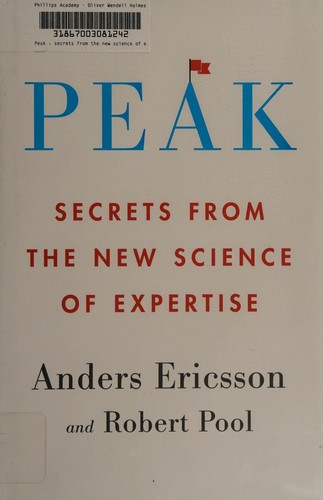
Peak: Secrets from the New Science of Expertise
Anders Ericsson and Robert Pool
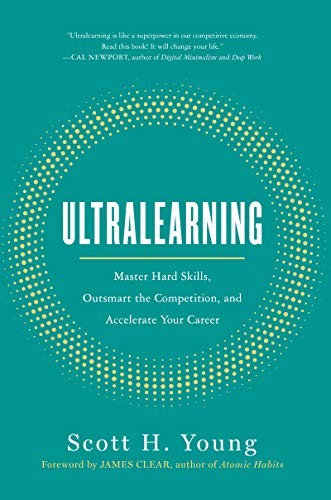
Ultralearning
Scott Young
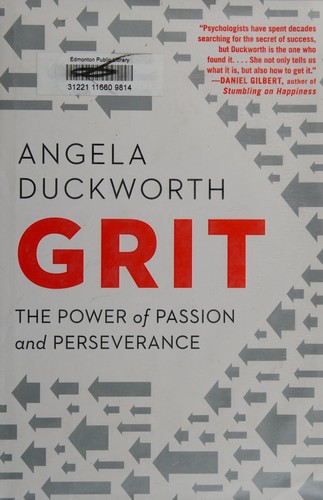
Grit: The Power of Passion and Perseverance
Angela Duckworth
Drive: The Surprising Truth About What Motivates Us
Daniel H. Pink
