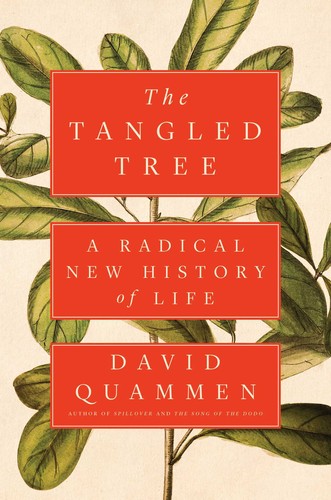
Talk to The Tangled Tree: A Radical New History of Life like its author wrote you back.
Get the ideas that fit your life — not generic summaries.
- Chat with the book
- Audiobook-style main ideas
- Adapts to your life and goals
- Helps you take action
What it argues
The Tangled Tree is David Quammen's account of how molecular biology overturned the traditional picture of the tree of life — the branching diagram, familiar since Darwin, that represents the evolution of all living things from a common ancestor. The central figure is Carl Woese, a molecular biologist at the University of Illinois who spent most of his career as an outsider and spent years sequencing ribosomal RNA across species to build a new classification of life. His work revealed a third domain of living things — the Archaea — that belonged neither to bacteria nor to the familiar eukaryotes, and it eventually revealed that the tree of life was tangled with horizontal gene transfers in ways that make the simple branching model misleading.
Horizontal gene transfer (HGT) means that organisms don't just pass genes vertically to their offspring — they also exchange genes laterally, across lineages and even across species. Bacteria do it constantly. But HGT happens in complex organisms too, and some of the most startling recent findings involve viruses and retroviruses inserting foreign genetic material into the genomes of animals and humans. About eight percent of the human genome consists of remnants of ancient viral infections. Evolution is partly an inheritance and partly an acquisition.
What it gets right
- 1.
Carl Woese's sequencing of ribosomal RNA revealed a third domain of life — the Archaea — that had been invisible under prior classification schemes based on visible cell features.
- 2.
Horizontal gene transfer allows organisms to pass genes to unrelated species, not just to offspring. Bacteria do it constantly; the phenomenon also occurs in complex animals.
- 3.
About eight percent of the human genome consists of remnants of ancient retroviral infections — genes acquired horizontally that have been incorporated into our lineage over millions of years.
What it covers
Who wrote it
David Quammen is an American science journalist and author based in Montana. He is a contributing writer for National Geographic and has written more than fifteen books, including The Song of the Dodo, Spillover, and Monster of God. His work on ecology, evolution, and infectious disease is known for its combination of scientific rigor and narrative storytelling. He has reported from the remote forests and wetlands where many of the most important biological discoveries are being made, and he writes with equal authority about molecular biology and field ecology.
