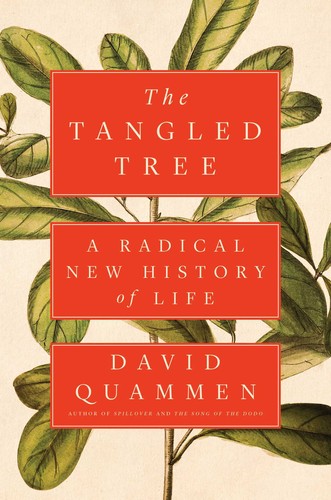
The Tangled Tree: A Radical New History of Life by David Quammen is a 2018 science book about evolution, molecular biology, tree of life. Carl Woese's sequencing of ribosomal RNA revealed a third domain of life — the Archaea — that had been invisible under prior classification schemes based on visible cell features.
Summary
The Tangled Tree is David Quammen's account of how molecular biology overturned the traditional picture of the tree of life — the branching diagram, familiar since Darwin, that represents the evolution of all living things from a common ancestor. The central figure is Carl Woese, a molecular biologist at the University of Illinois who spent most of his career as an outsider and spent years sequencing ribosomal RNA across species to build a new classification of life. His work revealed a third domain of living things — the Archaea — that belonged neither to bacteria nor to the familiar eukaryotes, and it eventually revealed that the tree of life was tangled with horizontal gene transfers in ways that make the simple branching model misleading.
Horizontal gene transfer (HGT) means that organisms don't just pass genes vertically to their offspring — they also exchange genes laterally, across lineages and even across species. Bacteria do it constantly. But HGT happens in complex organisms too, and some of the most startling recent findings involve viruses and retroviruses inserting foreign genetic material into the genomes of animals and humans. About eight percent of the human genome consists of remnants of ancient viral infections. Evolution is partly an inheritance and partly an acquisition.
Quammen is one of the best science writers alive, and the book works as both biography and intellectual history. Woese was difficult, obsessive, and profoundly underacknowledged during much of his career. The politics of how his ideas were initially rejected and then begrudgingly accepted are a case study in how paradigms resist replacement. The book also follows other researchers — notably Ford Doolittle and Lynn Margulis — whose work complicated the clean tree in different ways.
The implication Quammen draws out is vertiginous: if horizontal gene transfer is as widespread as evidence suggests, then the tree of life is less a tree and more a web, and the notion of a single common ancestor becomes complicated. The story of life is less linear than almost any textbook suggests.
Talk to The Tangled Tree: A Radical New History of Life like its author wrote you back.
Get the ideas that fit your life — not generic summaries.
- Chat with the book
- Audiobook-style main ideas
- Adapts to your life and goals
- Helps you take action
Key takeaways
- 1.
Carl Woese's sequencing of ribosomal RNA revealed a third domain of life — the Archaea — that had been invisible under prior classification schemes based on visible cell features.
- 2.
Horizontal gene transfer allows organisms to pass genes to unrelated species, not just to offspring. Bacteria do it constantly; the phenomenon also occurs in complex animals.
- 3.
About eight percent of the human genome consists of remnants of ancient retroviral infections — genes acquired horizontally that have been incorporated into our lineage over millions of years.
- 4.
The traditional tree-of-life diagram implies purely vertical inheritance, but the actual history of life involves so much lateral gene transfer that 'web' or 'ring' is a more accurate metaphor for early life.
- 5.
Woese's career illustrates how scientific communities resist paradigm-shifting ideas: his domain of Archaea was rejected or ignored for years before the evidence became overwhelming.
- 6.
Lynn Margulis's endosymbiotic theory — that mitochondria and chloroplasts were once independent bacteria absorbed into larger cells — was similarly dismissed and then vindicated.
- 7.
Horizontal gene transfer complicates medicine: antibiotic resistance genes spread between bacterial species through HGT far faster than vertical evolution would allow.
- 8.
The identity of LUCA — the last universal common ancestor — is more uncertain than textbooks suggest; the web of early gene transfer makes the concept hard to pin down precisely.
Discussion questions
Use these on your own, with a book club, or as chat starters in Superbook. Book club version, ready to copy or print →
- 1.
Woese spent years being ignored by the mainstream biology community. What does his story suggest about how science should handle heterodox researchers doing genuinely important work?
- 2.
The tree of life is one of biology's most iconic images. How do you feel about replacing it with something messier — a web or a ring? Does it make evolution feel more or less comprehensible?
- 3.
If eight percent of the human genome comes from ancient viral infections, how does that change your intuition about what it means to be human?
- 4.
Horizontal gene transfer is a major mechanism for spreading antibiotic resistance. Does understanding it change how you think about antibiotic use or the antibiotic resistance crisis?
- 5.
Quammen profiles Woese, Doolittle, and Margulis as scientists who were ahead of their fields for years. What do they have in common, and what does their experience suggest about the sociology of science?
- 6.
The book argues that early life on earth was so dominated by horizontal gene transfer that the concept of distinct species barely applies. Does that kind of deep strangeness in biological history interest or destabilize you?
- 7.
Lynn Margulis was also dismissed early in her career. How much of the resistance she and Woese faced do you think was about the science, and how much was about other factors?
- 8.
The book implies that our sense of individual biological identity — your genome is yours — is complicated by acquired DNA. How much does that matter philosophically?
- 9.
Quammen writes narrative science aimed at general readers. What does framing science through individual scientists gain or lose compared to a more conventional textbook approach?
- 10.
If horizontal gene transfer makes species boundaries blurry at the molecular level, does that affect how you think about conservation, biodiversity, or the value of preserving distinct species?
- 11.
Which finding in the book was most surprising to you? Did it change anything about your prior understanding of evolution?
- 12.
Quammen ends with questions rather than a tidy resolution. Is that an honest reflection of scientific uncertainty, or does it leave too much unresolved for a general reader?
Themes
Frequently asked questions
-
What is horizontal gene transfer and why does it matter?
Horizontal gene transfer is the movement of genetic material between organisms other than through normal reproduction — passed sideways between species rather than vertically from parent to offspring. It matters because it is a major mechanism of evolution, antibiotic resistance, and genome complexity that the standard tree-of-life picture doesn't capture.
-
Is The Tangled Tree worth reading for non-biologists?
Yes. Quammen is an excellent science writer who grounds the molecular biology in character-driven narrative. The Woese story is compelling even without a biology background. Some sections require sustained attention, but the book never becomes a textbook.
-
How long does it take to read The Tangled Tree?
Around seven to eight hours. At 461 pages it is substantial. The middle sections on rRNA sequencing are the densest; the opening biographical sections and the closing discussions of implications read faster.
-
What is the main argument of The Tangled Tree?
That horizontal gene transfer is so fundamental to the history of life that the tree-of-life metaphor is misleading, especially for early life. The book traces how this understanding emerged through the work of Carl Woese and others over fifty years of molecular biology.
-
Do I need to read The Song of the Dodo first?
No. The books are independent. The Song of the Dodo is about island biogeography and extinction; The Tangled Tree is about molecular evolution and the history of life. They share an author and a quality of writing but different subjects.