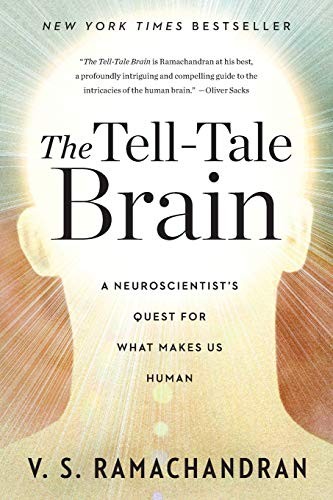
Talk to The Tell-Tale Brain: A Neuroscientist's Quest for What Makes Us Human like its author wrote you back.
Get the ideas that fit your life — not generic summaries.
- Chat with the book
- Audiobook-style main ideas
- Adapts to your life and goals
- Helps you take action
What it argues
The Tell-Tale Brain is V. S. Ramachandran's investigation into what neurological disorders can reveal about the normal brain. Ramachandran is a neurologist at UC San Diego known for using cheap, elegant experiments to probe questions that expensive brain imaging rarely settles. His method is to find patients with rare conditions — phantom limb pain, Capgras syndrome, body integrity identity disorder — and use their strange perceptions as windows into the neural machinery that ordinary people take for granted.
The book's opening chapters deal with body image and phantom sensations. Ramachandran's work on phantom limbs, for which he invented the mirror box therapy, shows that the brain's representation of the body is a malleable model, not a fixed read-out of physical reality. A patient whose arm was amputated can experience vivid sensation when their cheek is touched, because the sensory cortex reassigns territory. These remappings reveal how plastic and internally constructed the brain's body image actually is.
What it gets right
- 1.
Neurological disorders are not just clinical puzzles; they are natural experiments that reveal how normal brain processes work by showing what happens when they break down.
- 2.
The brain's body image is a constructed model, not a direct readout of the body. Phantom limb sensations and cortical remapping after amputation show how mutable that model is.
- 3.
The mirror box, a simple device using reflections, can reduce phantom limb pain by updating the brain's outdated motor map — evidence that low-cost interventions can change neural representations.
What it covers
Who wrote it
V. S. Ramachandran is a neurologist and director of the Center for Brain and Cognition at UC San Diego. He was born in India, trained in medicine at Madras University, and completed his PhD at Trinity College, Cambridge. He is best known for his work on phantom limbs, body image, and mirror neurons, and for developing the mirror box therapy for phantom limb pain. His earlier book Phantoms in the Brain covers similar territory and is often read alongside this one. He has received honorary doctorates from multiple universities and has been named one of the hundred most influential people in the world by Time magazine.
