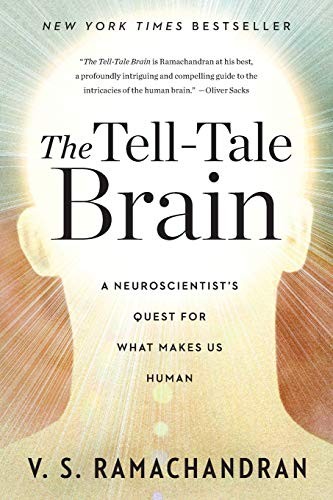
The Tell-Tale Brain: A Neuroscientist's Quest for What Makes Us Human by V. S. Ramachandran is a 2011 science book about neuroscience, consciousness, perception. Neurological disorders are not just clinical puzzles; they are natural experiments that reveal how normal brain processes work by showing what happens when they break down.
Summary
The Tell-Tale Brain is V. S. Ramachandran's investigation into what neurological disorders can reveal about the normal brain. Ramachandran is a neurologist at UC San Diego known for using cheap, elegant experiments to probe questions that expensive brain imaging rarely settles. His method is to find patients with rare conditions — phantom limb pain, Capgras syndrome, body integrity identity disorder — and use their strange perceptions as windows into the neural machinery that ordinary people take for granted.
The book's opening chapters deal with body image and phantom sensations. Ramachandran's work on phantom limbs, for which he invented the mirror box therapy, shows that the brain's representation of the body is a malleable model, not a fixed read-out of physical reality. A patient whose arm was amputated can experience vivid sensation when their cheek is touched, because the sensory cortex reassigns territory. These remappings reveal how plastic and internally constructed the brain's body image actually is.
Later chapters turn to more philosophically loaded territory: synesthesia, artistic savantism in autism, the evolution of mirror neurons and their possible role in empathy and language, and finally consciousness itself. Ramachandran argues that self-awareness, art appreciation, and language may all be consequences of particular neural architectures that arrived together in the evolutionary story of Homo sapiens. His treatment of mirror neurons — cells that fire both when an action is performed and when it is observed — is enthusiastic, though he acknowledges that the mirror neuron story was still unsettled when he wrote.
The book is strongest as a collection of extraordinary cases and the lateral thinking Ramachandran applies to them. He is less cautious than some colleagues about the speculative reaches of his interpretations, and readers should distinguish between the well-supported experimental findings and the more ambitious evolutionary and philosophical claims. What the book reliably delivers is a sense of the brain as a strange, cobbled-together inference machine that constructs reality rather than recording it.
Talk to The Tell-Tale Brain: A Neuroscientist's Quest for What Makes Us Human like its author wrote you back.
Get the ideas that fit your life — not generic summaries.
- Chat with the book
- Audiobook-style main ideas
- Adapts to your life and goals
- Helps you take action
Key takeaways
- 1.
Neurological disorders are not just clinical puzzles; they are natural experiments that reveal how normal brain processes work by showing what happens when they break down.
- 2.
The brain's body image is a constructed model, not a direct readout of the body. Phantom limb sensations and cortical remapping after amputation show how mutable that model is.
- 3.
The mirror box, a simple device using reflections, can reduce phantom limb pain by updating the brain's outdated motor map — evidence that low-cost interventions can change neural representations.
- 4.
Synesthesia, where senses cross (numbers have colors, music evokes touch), is not metaphor but a genuine difference in neural wiring that may shed light on how the brain constructs categories.
- 5.
Mirror neurons fire both when you perform an action and when you observe someone else performing it. Ramachandran speculates they may underlie empathy, imitation, and possibly language.
- 6.
Capgras syndrome — the belief that a loved one has been replaced by an impostor — results from a disconnection between the visual recognition system and the emotional response system. It shows that emotional resonance is a separate brain process from visual recognition.
- 7.
Consciousness may not be a single thing but a collection of distinct processes — attention, self-modeling, narrative construction — that usually operate together and give the impression of unity.
- 8.
Human capacities like art, metaphor, and humor may be evolutionary byproducts of brain systems that originally evolved for other functions, repurposed through the accident of neural architecture.
Discussion questions
Use these on your own, with a book club, or as chat starters in Superbook. Book club version, ready to copy or print →
- 1.
Ramachandran's method is to use rare disorders to illuminate normal function. What does this approach assume about the relationship between the normal and the abnormal brain?
- 2.
The phantom limb and mirror box work suggests the brain runs an internal model of the body that can be updated. What other 'models' do you think the brain constructs that are similarly malleable?
- 3.
Capgras syndrome separates visual recognition from emotional resonance. Does this change how you understand what it means to recognize someone you love?
- 4.
Ramachandran is more speculative about mirror neurons than some of his peers. How do you evaluate science writing that mixes well-supported findings with more ambitious interpretations?
- 5.
The book argues that artistic sensibility, empathy, and language might all trace to specific neural architectures. Does a neurological explanation of these capacities diminish or enrich your understanding of them?
- 6.
Synesthesia is presented as an extreme version of something all brains do — cross-activate across sensory and conceptual domains. Do you notice any mild synesthetic tendencies in yourself?
- 7.
Ramachandran suggests consciousness is not a single faculty but a cluster of related processes. How does that view change how you think about questions like free will or personal identity?
- 8.
The book is enthusiastic and occasionally overreaches. How do you read popular science that blends certainty with speculation, and when does enthusiasm become a problem?
- 9.
Phantom limb pain is the brain maintaining an outdated map. What other outdated 'maps' — emotional or cognitive — do people maintain long after the territory has changed?
- 10.
The cases in the book involve people whose inner experience diverges radically from external reality. What does this tell you about the reliability of your own perceptions?
- 11.
Ramachandran speculates that mirror neurons enabled the cultural explosion of human prehistory. How much explanatory weight do you think a single neural mechanism can carry?
- 12.
What is the most interesting single case or finding in the book, and what does it suggest to you beyond what Ramachandran explicitly argues?
Themes
Frequently asked questions
-
Is The Tell-Tale Brain accessible to non-scientists?
Yes. Ramachandran writes for a general audience and avoids technical jargon without sacrificing intellectual depth. The patient cases are compelling on their own, and the neuroscience is introduced gradually through the stories. Background in biology or psychology helps but is not required.
-
How does The Tell-Tale Brain differ from Phantoms in the Brain?
Phantoms in the Brain, Ramachandran's earlier book, covers the phantom limb and body image work in more detail. The Tell-Tale Brain is broader, extending into synesthesia, autism, mirror neurons, and consciousness. Readers who enjoyed Phantoms will find new material here, though some cases and arguments overlap.
-
Is the mirror neuron section reliable?
Ramachandran's enthusiasm for mirror neurons goes somewhat beyond what the evidence supported at the time of writing, and the field has since become more cautious about strong claims. The basic phenomena — neurons that respond to both performed and observed actions — are real. The broader claims about language and culture evolution remain speculative.
-
What is the book's most interesting case?
Capgras syndrome is one of the most striking: patients recognize a loved one's face perfectly but believe they are an impostor. Ramachandran explains it as a disconnection between the visual recognition system and the emotional memory system, demonstrating that emotional resonance is a separate and necessary component of truly recognizing another person.
-
Who should read The Tell-Tale Brain?
Anyone curious about consciousness, perception, and what makes humans distinctively human. It rewards readers who enjoy a blend of clinical detail and philosophical speculation. Those who prefer carefully bounded scientific claims may find Ramachandran's interpretive boldness frustrating.
Similar books
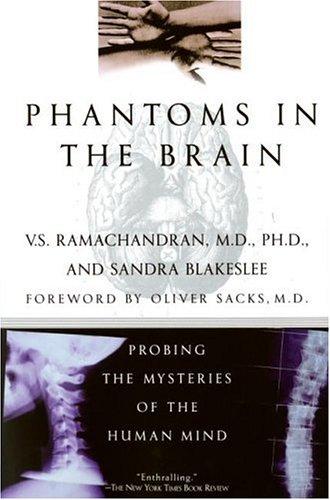
Phantoms in the Brain: Probing the Mysteries of the Human Mind
V. S. Ramachandran and Sandra Blakeslee
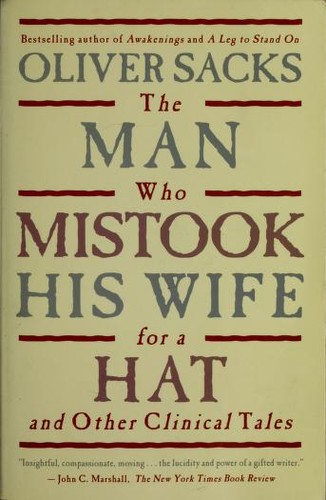
The Man Who Mistook His Wife for a Hat
Oliver Sacks
Incognito: The Secret Lives of the Brain
David Eagleman
How the Mind Works
Steven Pinker
