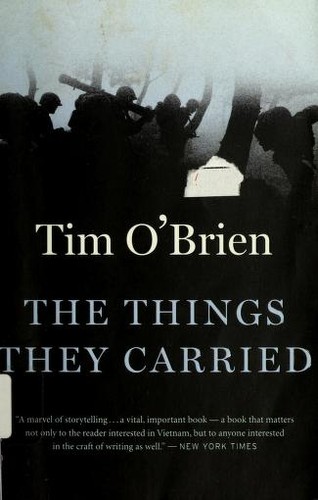
Talk to The Things They Carried like its author wrote you back.
Get the ideas that fit your life — not generic summaries.
- Chat with the book
- Audiobook-style main ideas
- Adapts to your life and goals
- Helps you take action
What it argues
Tim O'Brien served as a foot soldier in Vietnam in 1969 and 1970. The Things They Carried, published in 1990, is his most celebrated work — a collection of linked stories about a platoon of soldiers that blurs the line between fiction and memoir so deliberately that readers are still arguing about which category it belongs in. O'Brien is explicit about this ambiguity: the book includes a character named Tim O'Brien, and it contains a chapter arguing that the "story-truth" of fiction can be truer than literal fact. Whether any specific event happened exactly as written is, by design, unanswerable.
The opening title story catalogs the physical and emotional weight the soldiers carry — weapons, photographs, good-luck charms, letters from girlfriends, the weight of fear, the weight of memory — in a prose inventory that is also a meditation on what it means to carry something. This method of concrete accumulation as emotional meaning persists throughout the book. O'Brien consistently finds the moral truth of an experience in physical detail rather than in abstract reflection.
What it gets right
- 1.
O'Brien distinguishes between 'happening-truth' — what literally occurred — and 'story-truth' — what a story captures about the emotional and moral reality of an experience. He argues story-truth can be more true than fact.
- 2.
The physical inventory of what soldiers carry — including emotional weight, fear, and the memory of people they love — is a method for making the internal life of soldiers visible in concrete, specific terms.
- 3.
Moral injury in war often comes not from what was done to soldiers but from what soldiers did or failed to prevent. Several stories turn on acts of commission and omission that leave permanent psychological marks.
What it covers
Who wrote it
Tim O'Brien served as an infantry soldier in Vietnam with the United States Army from 1969 to 1970, reaching the rank of sergeant. He studied at Harvard after the war and became a full-time writer. In addition to The Things They Carried, his novels include Going After Cacciato (which won the National Book Award in 1979), The Nuclear Age, and In the Lake of the Woods. He has received fellowships from the Guggenheim Foundation and the National Endowment for the Arts. He teaches creative writing at Texas State University.
