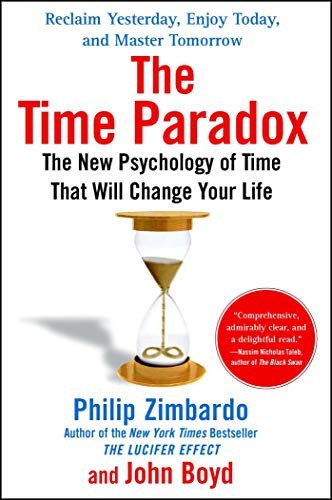
Talk to The Time Paradox like its author wrote you back.
Get the ideas that fit your life — not generic summaries.
- Chat with the book
- Audiobook-style main ideas
- Adapts to your life and goals
- Helps you take action
What it argues
The Time Paradox is built on a single, counterintuitive claim: that the most powerful force shaping your decisions is not your values, your personality, or your intelligence — it's your habitual time perspective. Zimbardo, the psychologist behind the Stanford Prison Experiment, spent decades developing the Zimbardo Time Perspective Inventory, a tool that measures how strongly a person orients toward the past (positive or negative), the present (hedonistic or fatalistic), or the future. The book argues that this orientation operates largely below conscious awareness and explains a surprising range of behavior: from drug addiction to career success to relationship satisfaction.
The research behind the book is substantial. People with strong future orientation delay gratification, plan effectively, and tend to achieve more in careers and finances — but they often sacrifice present enjoyment and relationships, struggle to stop working, and are prone to anxiety. People with strong present-hedonistic orientation enjoy life more intensely but have difficulty with long-term projects, savings, and health behavior. Past-negative orientation — dwelling on regret and resentment — is strongly associated with depression and low life satisfaction. Past-positive orientation, grounding identity in warm memories, buffers against stress.
What it gets right
- 1.
Time perspective — how much you orient toward past, present, or future — is the hidden driver of your decisions, often stronger than conscious values or intentions.
- 2.
The six time profiles: past-positive, past-negative, present-hedonistic, present-fatalistic, future, and transcendental future each predict different patterns of behavior and well-being.
- 3.
Future-oriented people achieve more professionally and financially but tend to sacrifice relationships, health, and present enjoyment — success and happiness can pull in opposite directions.
What it covers
Who wrote it
Philip Zimbardo is a professor emeritus of psychology at Stanford University, best known for conducting the 1971 Stanford Prison Experiment. Over a career spanning six decades he also founded the Heroic Imagination Project, wrote the textbook Psychology and Life, and chaired the American Psychological Association. John Boyd is a research psychologist and director of the Time Perspective Institute who collaborated with Zimbardo on developing the Zimbardo Time Perspective Inventory. The Time Paradox represents the culmination of both researchers' work on temporal orientation and behavior.
