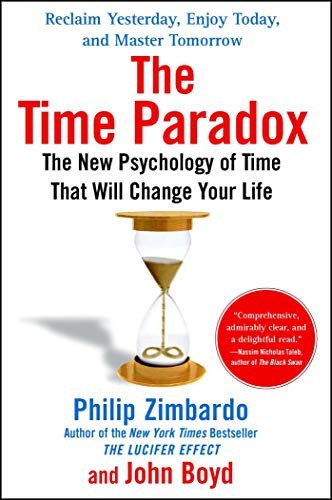
The Time Paradox by Philip Zimbardo and John Boyd is a 2008 psychology book about time perspective, decision-making, behavior. Time perspective — how much you orient toward past, present, or future — is the hidden driver of your decisions, often stronger than conscious values or intentions.
Summary
The Time Paradox is built on a single, counterintuitive claim: that the most powerful force shaping your decisions is not your values, your personality, or your intelligence — it's your habitual time perspective. Zimbardo, the psychologist behind the Stanford Prison Experiment, spent decades developing the Zimbardo Time Perspective Inventory, a tool that measures how strongly a person orients toward the past (positive or negative), the present (hedonistic or fatalistic), or the future. The book argues that this orientation operates largely below conscious awareness and explains a surprising range of behavior: from drug addiction to career success to relationship satisfaction.
The research behind the book is substantial. People with strong future orientation delay gratification, plan effectively, and tend to achieve more in careers and finances — but they often sacrifice present enjoyment and relationships, struggle to stop working, and are prone to anxiety. People with strong present-hedonistic orientation enjoy life more intensely but have difficulty with long-term projects, savings, and health behavior. Past-negative orientation — dwelling on regret and resentment — is strongly associated with depression and low life satisfaction. Past-positive orientation, grounding identity in warm memories, buffers against stress.
Zimbardo and Boyd don't argue for one profile as ideal. Instead, they propose a "balanced time perspective" — drawing on past-positive to sustain identity, present-hedonistic for enjoyment and relationships, and future-orientation for goals and planning. The book includes practical exercises for shifting time perspective, and explores how culture shapes collective temporal orientation, explaining differences in financial planning, punctuality norms, and long-term environmental stewardship across societies.
The book is most useful as a diagnostic. Taking the ZPTI and examining which profile dominates your thinking is genuinely illuminating for most readers. The prescriptive sections are less compelling — advice to "become more balanced" is vague enough to be hard to act on — but the conceptual framework is valuable precisely because it reframes familiar problems. Procrastination, impulsiveness, and dwelling on the past aren't character flaws; they're predictable outputs of a particular relationship with time.
Talk to The Time Paradox like its author wrote you back.
Get the ideas that fit your life — not generic summaries.
- Chat with the book
- Audiobook-style main ideas
- Adapts to your life and goals
- Helps you take action
Key takeaways
- 1.
Time perspective — how much you orient toward past, present, or future — is the hidden driver of your decisions, often stronger than conscious values or intentions.
- 2.
The six time profiles: past-positive, past-negative, present-hedonistic, present-fatalistic, future, and transcendental future each predict different patterns of behavior and well-being.
- 3.
Future-oriented people achieve more professionally and financially but tend to sacrifice relationships, health, and present enjoyment — success and happiness can pull in opposite directions.
- 4.
Past-negative orientation — ruminating on regrets and resentments — is among the strongest predictors of depression and life dissatisfaction.
- 5.
Past-positive orientation, grounding your identity in warm memories, acts as a psychological buffer against stress and sustains a stable sense of self.
- 6.
Cultures have collective time perspectives. Societies with high future-orientation tend toward economic development; those with high present-orientation tend toward relationship richness but less infrastructure planning.
- 7.
A balanced time perspective — integrating past-positive, present-hedonistic, and future — predicts better health and higher life satisfaction than any single dominant profile.
- 8.
Time perspective is not fixed. Deliberate practices — keeping a gratitude journal, learning to plan, scheduling present pleasures — can shift your habitual orientation over months.
Discussion questions
Use these on your own, with a book club, or as chat starters in Superbook. Book club version, ready to copy or print →
- 1.
Take the Zimbardo Time Perspective Inventory mentally. Which time zone dominates your decision-making — past, present, or future? Has it shifted at different stages of your life?
- 2.
Zimbardo argues that future-orientation drives achievement but damages relationships and present enjoyment. Where have you felt that tension personally?
- 3.
Past-negative orientation is linked to depression and resentment. Is there a past experience you return to that still shapes your present behavior more than it should?
- 4.
The book claims culture shapes collective time perspective. Do you recognize a cultural time bias in how your family, workplace, or national culture approaches planning versus enjoying the present?
- 5.
Which relationship in your life suffers most from a time-perspective mismatch — one person planning while the other wants to be present?
- 6.
Zimbardo's 'balanced time perspective' sounds appealing but is hard to define precisely. What would it actually look like in a typical week of your life?
- 7.
Think of a decision you regret. Was the regret caused by over-weighting the present, under-weighting the future, or something else entirely?
- 8.
Present-fatalistic people feel the future is fixed and effort is pointless. Where in your life do you hold that belief, even partially?
- 9.
The book argues that procrastination is often a time-perspective problem, not a laziness problem. Does that reframe how you think about something you've been avoiding?
- 10.
What does your relationship with past-positive memory look like? Do you have rituals for preserving and revisiting good memories, or do they fade quickly?
- 11.
How would you design a day that genuinely integrates all three time orientations — learning from the past, enjoying the present, and building toward the future?
- 12.
Zimbardo uses time-perspective theory to explain social problems like addiction and poverty. Is that framing useful or does it risk excusing structural factors?
Themes
Frequently asked questions
-
What is The Time Paradox about?
It argues that your habitual time perspective — how much you focus on past, present, or future — is the primary hidden driver of your decisions and life outcomes. The book presents research on six distinct time profiles and argues for a 'balanced' approach.
-
Is The Time Paradox worth reading?
For people who find the framework resonant after taking the ZPTI, yes. The diagnostic value is high. The prescriptive advice on becoming more balanced is less specific, so pair it with more actionable books if you want concrete exercises.
-
How long is The Time Paradox?
Around 320 pages. It reads in roughly six hours at average pace. The early chapters covering the research and profiles are the most engaging; the later chapters on culture and society are denser.
-
Who should read this book?
Anyone who wants to understand why they make the decisions they do, particularly around money, health, and long-term planning. Also useful for therapists, coaches, and people trying to understand behavior patterns that seem irrational on the surface.
-
What's the most actionable idea in the book?
Taking the Zimbardo Time Perspective Inventory and honestly reflecting on your dominant profile. Most people find one or two profiles explain a disproportionate number of their recurring frustrations, which is useful regardless of whether you then change anything.
Similar books
Thinking, Fast and Slow
Daniel Kahneman
Stumbling on Happiness
Daniel Gilbert
Four Thousand Weeks: Time Management for Mortals
Oliver Burkeman
The Happiness Hypothesis
Jonathan Haidt
