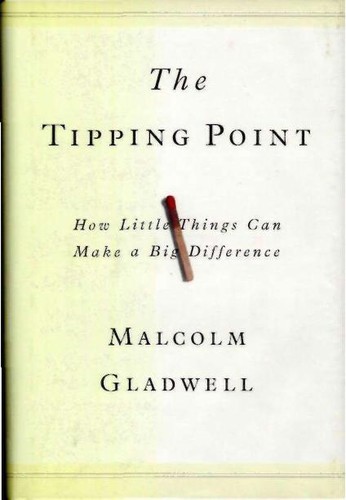
Talk to The Tipping Point like its author wrote you back.
Get the ideas that fit your life — not generic summaries.
- Chat with the book
- Audiobook-style main ideas
- Adapts to your life and goals
- Helps you take action
The Tipping Point, in detail
The Tipping Point is Malcolm Gladwell's argument that social change happens in sudden, dramatic ways — the same way a virus tips into an epidemic — and that understanding the mechanics of those tipping moments lets you engineer them. Gladwell's central claim is that ideas, products, messages, and behaviors spread according to a few predictable rules, and that small changes in the right places can produce large effects. The book is an extended case for why the world is not a linear place.
Gladwell organizes the argument around three rules. The Law of the Few says that a tiny number of people are responsible for most of the social transmission of an idea: Connectors (people who know everyone), Mavens (people who accumulate and share information), and Salesmen (people with unusual gifts of persuasion). The Stickiness Factor says content has to be memorable enough to compel action — and that whether something sticks often depends on minor changes in presentation rather than substance. The Power of Context says human beings are more sensitive to environment and situation than we assume; the same person will behave very differently depending on the immediate cues around them.
Gladwell illustrates each rule with a mix of social science research and case studies. Hush Puppies shoes making a comeback in Manhattan in the mid-1990s. Paul Revere's ride spreading alarm because Revere was a Connector. The dramatic drop in New York crime in the 1990s explained partly by the Broken Windows theory — the idea that small environmental cues like graffiti and fare-jumping signal that disorder is tolerated, and cleaning them up tips behavior back toward order. Sesame Street and Blue's Clues receive extended treatment on stickiness, with Gladwell tracing how small formatting changes made educational content land where earlier versions had slid right off.
The book rewards readers who want a lens for thinking about why some things catch on and others don't. Its weakness is the same as most social science pop writing of its era: the case studies are engaging but selective, and the framework can feel more descriptive than predictive after the fact. Still, the three rules are genuinely useful handles. Gladwell is not primarily writing a how-to manual — he is making a claim about the hidden logic of social change — and on that level the argument holds up.
The big ideas
- 1.
Ideas and behaviors spread like viruses. The conditions for tipping are specific: the right people, the right message, the right context.
- 2.
The Law of the Few: a handful of Connectors, Mavens, and Salesmen do the heavy lifting in any social epidemic. Finding them is more important than reaching the masses.
- 3.
Connectors are people with an unusually large and diverse social network. Their value is breadth and bridge-building between worlds that don't normally touch.
