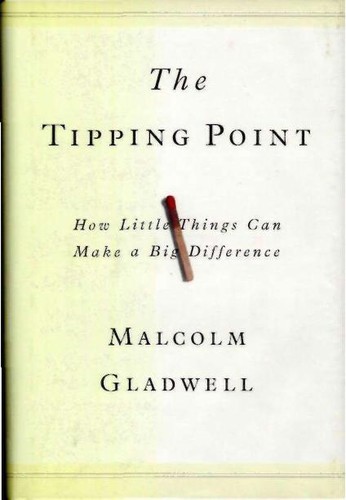
The Tipping Point by Malcolm Gladwell is a 2000 psychology book about social epidemics, word of mouth, influence. Ideas and behaviors spread like viruses. The conditions for tipping are specific: the right people, the right message, the right context.
Summary
The Tipping Point is Malcolm Gladwell's argument that social change happens in sudden, dramatic ways — the same way a virus tips into an epidemic — and that understanding the mechanics of those tipping moments lets you engineer them. Gladwell's central claim is that ideas, products, messages, and behaviors spread according to a few predictable rules, and that small changes in the right places can produce large effects. The book is an extended case for why the world is not a linear place.
Gladwell organizes the argument around three rules. The Law of the Few says that a tiny number of people are responsible for most of the social transmission of an idea: Connectors (people who know everyone), Mavens (people who accumulate and share information), and Salesmen (people with unusual gifts of persuasion). The Stickiness Factor says content has to be memorable enough to compel action — and that whether something sticks often depends on minor changes in presentation rather than substance. The Power of Context says human beings are more sensitive to environment and situation than we assume; the same person will behave very differently depending on the immediate cues around them.
Gladwell illustrates each rule with a mix of social science research and case studies. Hush Puppies shoes making a comeback in Manhattan in the mid-1990s. Paul Revere's ride spreading alarm because Revere was a Connector. The dramatic drop in New York crime in the 1990s explained partly by the Broken Windows theory — the idea that small environmental cues like graffiti and fare-jumping signal that disorder is tolerated, and cleaning them up tips behavior back toward order. Sesame Street and Blue's Clues receive extended treatment on stickiness, with Gladwell tracing how small formatting changes made educational content land where earlier versions had slid right off.
The book rewards readers who want a lens for thinking about why some things catch on and others don't. Its weakness is the same as most social science pop writing of its era: the case studies are engaging but selective, and the framework can feel more descriptive than predictive after the fact. Still, the three rules are genuinely useful handles. Gladwell is not primarily writing a how-to manual — he is making a claim about the hidden logic of social change — and on that level the argument holds up.
Talk to The Tipping Point like its author wrote you back.
Get the ideas that fit your life — not generic summaries.
- Chat with the book
- Audiobook-style main ideas
- Adapts to your life and goals
- Helps you take action
Key takeaways
- 1.
Ideas and behaviors spread like viruses. The conditions for tipping are specific: the right people, the right message, the right context.
- 2.
The Law of the Few: a handful of Connectors, Mavens, and Salesmen do the heavy lifting in any social epidemic. Finding them is more important than reaching the masses.
- 3.
Connectors are people with an unusually large and diverse social network. Their value is breadth and bridge-building between worlds that don't normally touch.
- 4.
Mavens accumulate knowledge and feel compelled to share it. They are the information brokers who notice price discrepancies, read the fine print, and tell everyone they know.
- 5.
Stickiness is not the same as quality or volume. A message tips when something in its structure — often a small formatting or sequencing change — makes it impossible to forget.
- 6.
The Power of Context: people are far more influenced by their immediate environment than by their character. The same person behaves differently in a clean hallway versus a graffiti-covered one.
- 7.
The Broken Windows theory suggests that visible signs of minor disorder invite larger disorder. Cleaning up the small stuff can tip an environment toward order.
- 8.
Groups have a natural size limit for close social bonding — around 150 people. Organizations that exceed this threshold often see culture and behavior change in ways their founders didn't intend.
Discussion questions
Use these on your own, with a book club, or as chat starters in Superbook. Book club version, ready to copy or print →
- 1.
Gladwell says a few people carry most of the weight in spreading ideas. Do you know a Connector, a Maven, and a Salesman in your own life? What distinguishes each?
- 2.
Think of a product, idea, or behavior that spread rapidly in your social circle. Which of the three rules — the Few, Stickiness, or Context — best explains why it caught on?
- 3.
The Broken Windows theory argues that small environmental signals matter enormously. What small signal in your own environment might be shaping your behavior without your noticing?
- 4.
Gladwell argues that the messenger often matters more than the message. When have you accepted an idea from one person that you would have dismissed from another?
- 5.
Is stickiness something you can engineer, or does it emerge after the fact? Think of an attempt you've seen to make an idea sticky that didn't work.
- 6.
The 150-person rule suggests there's a natural ceiling on functional group size. Does this match your experience with teams, communities, or organizations you've been part of?
- 7.
Gladwell profiles the New York crime drop as a context story. Do you find the Broken Windows explanation convincing, or does it leave important causes out?
- 8.
Mavens feel a compulsion to share information. Who in your life fills this role? What are the costs and benefits of being a Maven?
- 9.
The Tipping Point was published in 2000. Which of its case studies feel dated, and which still seem to explain something true about how things spread?
- 10.
Social media changed the mechanics of contagion after this book was written. Would Gladwell's three rules need to be revised to account for how Twitter or TikTok works?
- 11.
Gladwell distinguishes between social epidemics that are good (anti-smoking campaigns) and those that are not (teen suicide clusters). What responsibility comes with understanding these mechanics?
- 12.
If you were trying to tip an idea in your organization or community, which of the three rules would you focus on first and why?
Themes
Frequently asked questions
-
What is The Tipping Point about?
It argues that social change — ideas, products, behaviors — spreads the way viruses do, and that tipping moments follow predictable rules involving a few key people, sticky messages, and the power of context. Gladwell's goal is to explain why some things catch on and others don't.
-
Is The Tipping Point still worth reading?
Yes, with the caveat that some of its social science research has been challenged since 2000, and social media has changed the mechanics of contagion significantly. The three-rule framework is still a useful thinking tool; just don't treat the case studies as settled evidence.
-
How long does it take to read The Tipping Point?
Around five hours at average reading pace. The 280-page book is structured in self-contained chapters and reads quickly. Most readers finish it in two or three sittings.
-
Who should read The Tipping Point?
Anyone who wants a mental model for why some ideas spread and others don't — marketers, managers, educators, public health workers, and organizers in particular. It is less useful if you want rigorous experimental evidence rather than well-chosen case studies.
-
What is the most useful idea in The Tipping Point?
The Law of the Few, specifically the distinction between Connectors, Mavens, and Salesmen. Most people try to reach audiences broadly; Gladwell's argument is that finding the right three or four individuals does more work than any broadcast campaign.
-
How does The Tipping Point relate to Gladwell's other books?
It established the template he returned to: a big counterintuitive claim, a handful of memorable case studies, and social science research woven through. Outliers and Blink use the same structure. Readers who enjoy one usually enjoy the others, though Outliers tends to get the strongest reviews.
Similar books
Outliers: The Story of Success
Malcolm Gladwell
Blink: The Power of Thinking Without Thinking
Malcolm Gladwell
Thinking, Fast and Slow
Daniel Kahneman
Influence: The Psychology of Persuasion
Robert B. Cialdini
