Talk to The Undoing Project like its author wrote you back.
Get the ideas that fit your life — not generic summaries.
- Chat with the book
- Audiobook-style main ideas
- Adapts to your life and goals
- Helps you take action
The Undoing Project, in detail
Michael Lewis came to this subject sideways. After writing Moneyball, he received a letter pointing out that the Oakland A's statistical revolution had been anticipated by Israeli psychologists decades earlier. The psychologists were Daniel Kahneman and Amos Tversky, who between the late 1960s and Tversky's death in 1996 produced the most influential body of work in behavioral economics through a collaboration so close it was described as a single mind in two bodies.
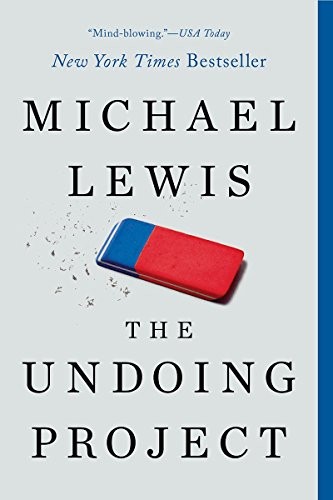
The Undoing Project, published in 2016, is the story of that collaboration — how two people from opposite psychological and intellectual temperaments met in Israel, recognized something in each other, and spent decades producing discoveries about how humans actually make judgments under uncertainty. It is partly a biography of both men, partly a history of ideas, and entirely Lewis's kind of book: driven by character and conflict, using narrative to make difficult ideas accessible.
Kahneman and Tversky's core discoveries include: the availability heuristic (we judge probability by how easily an example comes to mind), the representativeness heuristic (we judge probability by how much something resembles a prototype), anchoring (estimates are biased toward an initial reference point), loss aversion (losses hurt roughly twice as much as equivalent gains feel good), and the simulation heuristic (we judge how bad an outcome was by how easily we can imagine the counterfactual). These are the building blocks of what became Thinking, Fast and Slow.
Lewis spends as much time on the friendship and eventual tension between the two men as on the ideas themselves. Tversky was charismatic, sure of himself, and consumed enormous intellectual oxygen. Kahneman was more anxious and more self-doubting. The collaboration was genuine and the ideas were joint, but the credit allocation outside the collaboration was not, and this eventually created a wound that neither fully healed. The Undoing Project is more about people than about biases, and that makes it a more humane book than a straightforward account of the research would be.
The big ideas
- 1.
The availability heuristic leads people to judge probability by how easily examples come to mind. Events that are vivid, recent, or emotionally salient seem more probable than they are.
- 2.
The representativeness heuristic leads to errors when superficial resemblance to a prototype overrides base-rate information. The conjunction fallacy is its most famous demonstration.
- 3.
Loss aversion is not symmetric: losing a given amount hurts more than gaining the same amount feels good. This asymmetry shapes decisions in ways that are often irrational.
