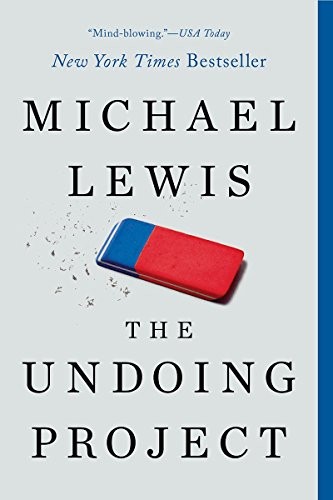
The Undoing Project by Michael Lewis is a 2016 psychology book about cognitive bias, decision-making, friendship. The availability heuristic leads people to judge probability by how easily examples come to mind. Events that are vivid, recent, or emotionally salient seem more probable than they are.
Summary
Michael Lewis came to this subject sideways. After writing Moneyball, he received a letter pointing out that the Oakland A's statistical revolution had been anticipated by Israeli psychologists decades earlier. The psychologists were Daniel Kahneman and Amos Tversky, who between the late 1960s and Tversky's death in 1996 produced the most influential body of work in behavioral economics through a collaboration so close it was described as a single mind in two bodies.
The Undoing Project, published in 2016, is the story of that collaboration — how two people from opposite psychological and intellectual temperaments met in Israel, recognized something in each other, and spent decades producing discoveries about how humans actually make judgments under uncertainty. It is partly a biography of both men, partly a history of ideas, and entirely Lewis's kind of book: driven by character and conflict, using narrative to make difficult ideas accessible.
Kahneman and Tversky's core discoveries include: the availability heuristic (we judge probability by how easily an example comes to mind), the representativeness heuristic (we judge probability by how much something resembles a prototype), anchoring (estimates are biased toward an initial reference point), loss aversion (losses hurt roughly twice as much as equivalent gains feel good), and the simulation heuristic (we judge how bad an outcome was by how easily we can imagine the counterfactual). These are the building blocks of what became Thinking, Fast and Slow.
Lewis spends as much time on the friendship and eventual tension between the two men as on the ideas themselves. Tversky was charismatic, sure of himself, and consumed enormous intellectual oxygen. Kahneman was more anxious and more self-doubting. The collaboration was genuine and the ideas were joint, but the credit allocation outside the collaboration was not, and this eventually created a wound that neither fully healed. The Undoing Project is more about people than about biases, and that makes it a more humane book than a straightforward account of the research would be.
Talk to The Undoing Project like its author wrote you back.
Get the ideas that fit your life — not generic summaries.
- Chat with the book
- Audiobook-style main ideas
- Adapts to your life and goals
- Helps you take action
Key takeaways
- 1.
The availability heuristic leads people to judge probability by how easily examples come to mind. Events that are vivid, recent, or emotionally salient seem more probable than they are.
- 2.
The representativeness heuristic leads to errors when superficial resemblance to a prototype overrides base-rate information. The conjunction fallacy is its most famous demonstration.
- 3.
Loss aversion is not symmetric: losing a given amount hurts more than gaining the same amount feels good. This asymmetry shapes decisions in ways that are often irrational.
- 4.
Anchoring biases estimates toward an initial value, even when that value is arbitrary. Negotiators, doctors, and judges all show anchoring effects in predictable directions.
- 5.
Regret is asymmetric. We regret actions more than inactions in the short term, and inactions more than actions in the long term. Kahneman and Tversky studied this as part of counterfactual thinking.
- 6.
The undoing project — the title concept — refers to counterfactual mental simulation: imagining how things could have gone differently. The ease of this simulation determines how much regret or relief we feel.
- 7.
Expert judgment in high-stakes domains — medicine, finance, sports recruitment — is more fallible than experts believe, and statistical models often outperform clinical or professional judgment.
- 8.
The collaboration between Kahneman and Tversky was genuinely joint, but the recognition was not equally distributed. Credit allocation shapes scientific careers and relationships in ways that research partnerships often obscure.
Discussion questions
Use these on your own, with a book club, or as chat starters in Superbook. Book club version, ready to copy or print →
- 1.
Lewis focuses on the friendship as much as the ideas. What does the relationship between Kahneman and Tversky suggest about how important collaborations actually work?
- 2.
The availability heuristic means vivid, recent events seem more probable. Where in your own thinking do you notice this most?
- 3.
Loss aversion shapes how people evaluate risks. Can you think of a recent decision in your own life where you were more motivated by avoiding a loss than gaining an equivalent good?
- 4.
Kahneman was more anxious than Tversky and doubted his contributions more. The credit allocation reflected Tversky's charisma rather than the actual division of work. How do you think about this kind of imbalance in collaborations you have been part of?
- 5.
Lewis came to this subject through Moneyball and the challenge to expert judgment in baseball. In what other domains do you think statistical models are outperforming expert intuition, and where is expert intuition genuinely better?
- 6.
The conjunction fallacy — the Linda the bank teller example — shows that people judge 'Linda is a bank teller and a feminist activist' as more probable than 'Linda is a bank teller.' Have you made this error or observed others making it?
- 7.
Counterfactual thinking — imagining how things could have gone differently — shapes regret. How do you experience the simulation of alternative outcomes after disappointments?
- 8.
Lewis argues that Moneyball revealed the depth of systematic bias in expert sports judgment. How did it feel to read that the biases Kahneman and Tversky described show up in professional domains with high stakes and lots of data?
- 9.
Tversky died before Kahneman received the Nobel Prize, which is not awarded posthumously. How do you think about credit and recognition in collaborations that span decades?
- 10.
The book ends with the suggestion that many of our most confident intuitions about people, probabilities, and outcomes are systematically wrong. Does that generate humility in you or resistance?
- 11.
Which of the biases described in the book do you think has the most practical cost in everyday decisions?
Themes
Frequently asked questions
-
Do I need to read Thinking, Fast and Slow first?
No. The Undoing Project covers the research through narrative rather than systematic explanation, so it works as a standalone. If you want the full theoretical framework, read Kahneman's own book; if you want the human story behind it, Lewis is the better starting point.
-
Is this a biography?
Partly. It is more accurately a dual portrait organized around an intellectual collaboration. Lewis is interested in both the ideas and the men who produced them, and neither can be understood separately.
-
What is the undoing project?
A term Kahneman and Tversky used for research on counterfactual thinking — the mental process of imagining how events could have gone differently. The title captures both this research and the sense that their collaboration gradually unraveled toward the end.
-
Does the book cover all of Kahneman and Tversky's work?
No. It focuses on the heuristics and biases program and prospect theory. Some later work, including Kahneman's elaboration of System 1 and System 2 thinking, gets less attention. For the complete framework, Thinking, Fast and Slow is the primary source.
-
Is this worth reading if I have already read Thinking, Fast and Slow?
Yes, for different reasons. Lewis provides context, biography, and narrative that Kahneman's own book does not. Understanding the collaboration and the men behind it enriches the ideas considerably.
Similar books
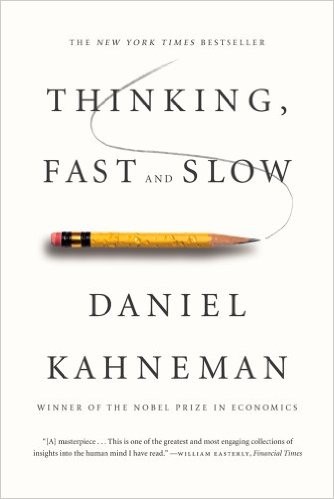
Thinking, Fast and Slow
Daniel Kahneman
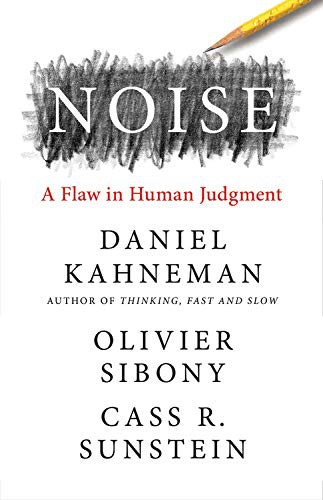
Noise: A Flaw in Human Judgment
Daniel Kahneman, Olivier Sibony, and Cass R. Sunstein
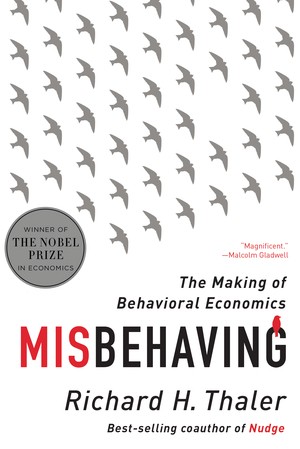
Misbehaving: The Making of Behavioral Economics
Richard H. Thaler
The Art of Thinking Clearly
Rolf Dobelli
