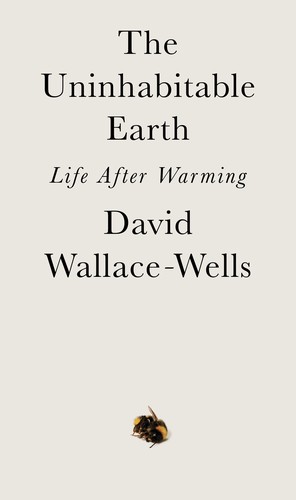
Talk to The Uninhabitable Earth: Life After Warming like its author wrote you back.
Get the ideas that fit your life — not generic summaries.
- Chat with the book
- Audiobook-style main ideas
- Adapts to your life and goals
- Helps you take action
The Uninhabitable Earth: Life After Warming, in detail
The Uninhabitable Earth is David Wallace-Wells's catalog of what climate change will do to human civilization if carbon emissions continue on or near their current trajectory. The book began as a widely read 2017 New York magazine article and was expanded into a comprehensive survey of climate impacts across food, water, disease, conflict, economics, and psychology. Wallace-Wells is not a scientist but a journalist, and his approach is explicitly to present the worst-case scientific literature, not the central estimates, because he believes the range of what is possible has not been absorbed by the public.
The book's structure is systematic. Wallace-Wells moves through distinct categories of harm: heat death, as wet-bulb temperatures in parts of the tropics approach the limit of what human physiology can tolerate; hunger, as agricultural yields decline and weather patterns become less predictable; drowning, as sea levels rise; wildfire; freshwater scarcity; dying oceans; unbreathable air; plagues made more likely by warming; and economic collapse. Each chapter marshals scientific research into a relentless accumulation of likely consequences. The tone is neither neutral nor despairing — it is urgent and occasionally polemical.
The second half turns to cultural and political responses. Wallace-Wells is skeptical of techno-optimism but not dismissive of it. He argues that carbon capture and solar geoengineering might buy time but will not substitute for emissions reductions. He is scathing about the inadequacy of current policy frameworks and the cognitive biases that make sustained action on a slow-moving but exponentially worsening crisis so difficult for democratic governments to produce.
The book is deliberately uncomfortable. Wallace-Wells acknowledges that writing about worst-case scenarios risks inducing fatalism, but argues that the current problem is insufficient alarm, not excessive doom. Not everyone agrees with that framing — some climate scientists have criticized the book for emphasizing catastrophic tail risks in ways that can paralyze rather than motivate. That criticism is worth taking seriously, but the book remains the most thorough single-volume survey of what the science says could happen.
The big ideas
- 1.
On current emissions trajectories, warming of 3-4 degrees Celsius above pre-industrial levels is likely by 2100, producing impacts across food, water, health, and economics that exceed what most people have absorbed.
- 2.
Wet-bulb temperatures above 35 degrees Celsius are lethal to humans regardless of shade or hydration; parts of the tropics will exceed this threshold more frequently under 4-degree warming.
- 3.
Agricultural yields of staple crops are expected to fall significantly per degree of warming. Feeding ten billion people at 3 or 4 degrees will require transformations beyond anything modern agriculture has managed.
