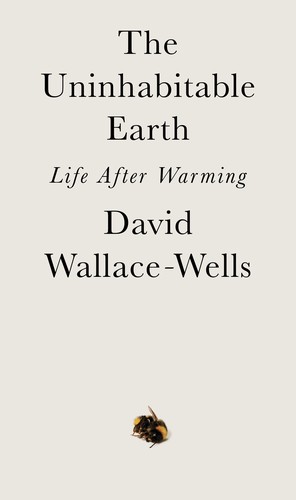
The Uninhabitable Earth: Life After Warming by David Wallace-Wells is a 2019 science book about climate change, extinction, politics. On current emissions trajectories, warming of 3-4 degrees Celsius above pre-industrial levels is likely by 2100, producing impacts across food, water, health, and economics that exceed what most people have absorbed.
Summary
The Uninhabitable Earth is David Wallace-Wells's catalog of what climate change will do to human civilization if carbon emissions continue on or near their current trajectory. The book began as a widely read 2017 New York magazine article and was expanded into a comprehensive survey of climate impacts across food, water, disease, conflict, economics, and psychology. Wallace-Wells is not a scientist but a journalist, and his approach is explicitly to present the worst-case scientific literature, not the central estimates, because he believes the range of what is possible has not been absorbed by the public.
The book's structure is systematic. Wallace-Wells moves through distinct categories of harm: heat death, as wet-bulb temperatures in parts of the tropics approach the limit of what human physiology can tolerate; hunger, as agricultural yields decline and weather patterns become less predictable; drowning, as sea levels rise; wildfire; freshwater scarcity; dying oceans; unbreathable air; plagues made more likely by warming; and economic collapse. Each chapter marshals scientific research into a relentless accumulation of likely consequences. The tone is neither neutral nor despairing — it is urgent and occasionally polemical.
The second half turns to cultural and political responses. Wallace-Wells is skeptical of techno-optimism but not dismissive of it. He argues that carbon capture and solar geoengineering might buy time but will not substitute for emissions reductions. He is scathing about the inadequacy of current policy frameworks and the cognitive biases that make sustained action on a slow-moving but exponentially worsening crisis so difficult for democratic governments to produce.
The book is deliberately uncomfortable. Wallace-Wells acknowledges that writing about worst-case scenarios risks inducing fatalism, but argues that the current problem is insufficient alarm, not excessive doom. Not everyone agrees with that framing — some climate scientists have criticized the book for emphasizing catastrophic tail risks in ways that can paralyze rather than motivate. That criticism is worth taking seriously, but the book remains the most thorough single-volume survey of what the science says could happen.
Talk to The Uninhabitable Earth: Life After Warming like its author wrote you back.
Get the ideas that fit your life — not generic summaries.
- Chat with the book
- Audiobook-style main ideas
- Adapts to your life and goals
- Helps you take action
Key takeaways
- 1.
On current emissions trajectories, warming of 3-4 degrees Celsius above pre-industrial levels is likely by 2100, producing impacts across food, water, health, and economics that exceed what most people have absorbed.
- 2.
Wet-bulb temperatures above 35 degrees Celsius are lethal to humans regardless of shade or hydration; parts of the tropics will exceed this threshold more frequently under 4-degree warming.
- 3.
Agricultural yields of staple crops are expected to fall significantly per degree of warming. Feeding ten billion people at 3 or 4 degrees will require transformations beyond anything modern agriculture has managed.
- 4.
Sea level rise is not primarily a distant-century problem: storm surges and flooding are already intensifying, and coastal economies are beginning to discount flood-prone real estate.
- 5.
Climate change is expected to increase the geographic range of many infectious diseases, including malaria and dengue, while also creating conditions for new zoonotic outbreaks.
- 6.
Economic models of climate damage are likely to significantly underestimate actual costs because they don't adequately capture non-linear tipping points and compound effects.
- 7.
Cognitive biases around slow-moving threats, hyperbolic discounting of future harm, and the psychological distance of abstract statistics make sustained democratic action on climate extremely difficult.
- 8.
Wallace-Wells argues that optimism and doom are both failure modes: the necessary response is engaged, realistic attention to both what is likely and what is still preventable.
Discussion questions
Use these on your own, with a book club, or as chat starters in Superbook. Book club version, ready to copy or print →
- 1.
Wallace-Wells deliberately presents worst-case scenarios. Do you find that a responsible framing for climate communication, or does it risk inducing fatalism?
- 2.
The book argues that current policy frameworks are inadequate for the scale of the problem. What would adequate policy look like, and who would need to be persuaded to support it?
- 3.
How has reading this book changed, if at all, your emotional relationship to climate change as a problem — more anxious, more motivated, more resigned, or something else?
- 4.
Wallace-Wells is critical of techno-optimism but does not dismiss technology solutions entirely. Where do you place solar geoengineering or carbon capture in the realistic toolkit?
- 5.
The economic sections argue that climate change will cost far more than current models estimate. How should policymakers handle large uncertainty ranges in economic projections of harm?
- 6.
The book identifies specific regions — the Persian Gulf, South Asia — where heat death may become a regular feature of summer. What obligations do wealthy countries have to those populations?
- 7.
Wallace-Wells mentions that past climate communications may have focused too much on distant future scenarios. Do you think the framing of climate change in media has improved, worsened, or stayed roughly the same since this book was published?
- 8.
The chapter on climate and conflict argues that resource scarcity and heat stress increase violence. Does that causal claim seem convincing to you, and what would change your mind?
- 9.
Some climate scientists criticized the book for emphasizing catastrophic tail risks. Is there a meaningful difference between presenting the worst plausible science accurately and fearmongering?
- 10.
How much of your own lifestyle changes would you make — in diet, travel, or consumption — if you were confident they would make a meaningful collective difference?
- 11.
Wallace-Wells writes from New York. How differently might this book read if written from Bangladesh, the Sahel, or the Maldives?
- 12.
What is the most important fact you learned from this book that you think the average person doesn't know?
Themes
Frequently asked questions
-
Is The Uninhabitable Earth too scary to be useful?
That is the central debate about the book. Wallace-Wells argues that the problem with current climate discourse is insufficient alarm, not too much. Some climate scientists disagree, arguing that emphasizing worst cases can induce helplessness. Whether the book is useful depends on whether you find urgency motivating or paralyzing.
-
What is the main argument of The Uninhabitable Earth?
That the full range of scientific projections for climate change — not just the central estimates — has not been absorbed by the public or by policymakers, and that understanding the worst plausible scenarios is necessary for appropriate response.
-
How does this compare to other climate books?
It is more comprehensive in its survey of impacts than most, covering everything from heat death to economic modeling. It is more journalistic and less solutions-focused than something like Drawdown, and more catastrophist in tone than most mainstream climate science communication.
-
Is the science in the book accurate?
Largely yes, though it emphasizes high-end projections. Wallace-Wells cites scientific literature throughout. Some scientists have said he presents tail risks without adequately communicating their probability; he responds that tail risks have been consistently underweighted in public communication.
-
Who should read The Uninhabitable Earth?
Anyone who wants a thorough, unsanitized account of what climate science says is possible. It is most useful for people who feel the issue has not landed emotionally despite years of exposure to climate coverage, and who want to understand the full scope of what is at stake.
Similar books
This Changes Everything: Capitalism vs. The Climate
Naomi Klein
The Sixth Extinction: An Unnatural History
Elizabeth Kolbert
Silent Spring
Rachel Carson

The Fate of Food: What We'll Eat in a Bigger, Hotter, Smarter World
Amanda Little
