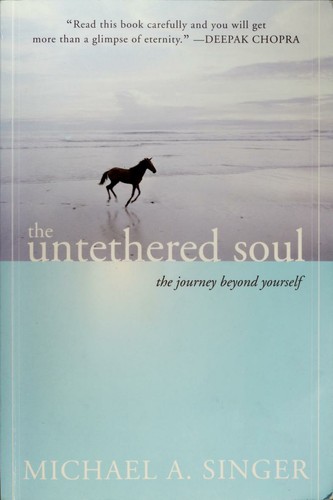
Talk to The Untethered Soul like its author wrote you back.
Get the ideas that fit your life — not generic summaries.
- Chat with the book
- Audiobook-style main ideas
- Adapts to your life and goals
- Helps you take action
The Untethered Soul, in detail
The Untethered Soul is Michael Singer's guide to liberation through the direct investigation of consciousness — specifically, the question of who or what is aware of the constant stream of thoughts, emotions, and sensations that constitute ordinary experience. Published in 2007 and gradually becoming a word-of-mouth bestseller, it does not belong to any formal religious tradition but draws on Vedantic, yogic, and Buddhist insights in a practical, accessible framework.
Singer's central insight is the distinction between the witnessing consciousness and its contents. The voice in the head — the narrator who comments on everything, who worries, plans, judges, and reminisces — is not you; it is something you observe. If you can witness the voice, you are the witness, not the voice. This simple observation, which Singer treats as the foundational move of all genuine spiritual practice, is the beginning of liberation. Once you see that you are the observer and not the observed, the tightening grip of compulsive thought loosens.
The book develops this through an analysis of what Singer calls the "seat of consciousness" — the quality of awareness that is always present regardless of what it is aware of. It then explores what blocks the free flow of inner energy: stored emotional experiences, defended vulnerabilities, and the habitual contraction of the heart when confronted with difficulty. The central practice Singer recommends is not suppression or analysis but what he calls "staying open" — allowing difficult experiences to pass through rather than blocking them, which would store them as psychological tightness.
The final section, on liberation and death, is the most demanding philosophically. Singer argues that the fear of death is rooted in identification with the limited self rather than with the eternal witness. The person who has genuinely shifted their identity to consciousness rather than its contents experiences ordinary life as a series of extraordinary events but is not disturbed by any of them. This is presented not as an exotic spiritual achievement but as the natural consequence of the shift in identity the book describes from the beginning.
The big ideas
- 1.
You are not the voice in your head — you are the one who is aware of the voice. This distinction is the foundation of genuine spiritual practice.
- 2.
The witnessing consciousness is always present, always the same quality, regardless of what it witnesses — pleasure, pain, boredom, exaltation.
- 3.
Stored emotional experiences block the free flow of inner energy; the practice is not suppression or analysis but staying open so that experiences can pass through.
