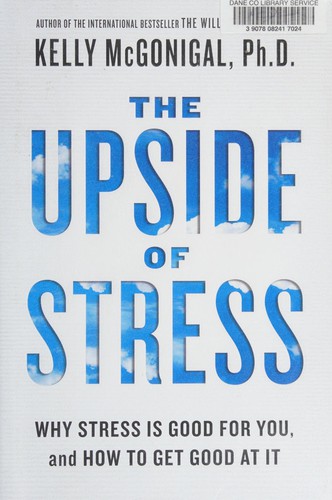
Talk to The Upside of Stress like its author wrote you back.
Get the ideas that fit your life — not generic summaries.
- Chat with the book
- Audiobook-style main ideas
- Adapts to your life and goals
- Helps you take action
The Upside of Stress, in detail
The Upside of Stress is Kelly McGonigal's evidence-based argument that the harm of stress is mediated less by stress itself than by the belief that stress is harmful. McGonigal, a health psychologist and Stanford lecturer, begins with a striking epidemiological finding: a study of 30,000 adults found that high stress was associated with increased mortality — but only for people who believed stress was harmful. High-stress individuals who did not believe stress was harmful had lower mortality rates than low-stress individuals, regardless of how much stress they reported experiencing. This opened a question she spent a book trying to answer: what if the problem is not stress but our relationship to it?
The book covers the biology of the stress response in some depth, noting that the conventional "fight-or-flight" description is incomplete. The stress response has multiple forms: challenge, threat, tend-and-befriend, and excite-and-delight responses engage different hormonal profiles with different downstream effects. The conventional version — cortisol and adrenaline, heart rate up, performance degraded — is only one pattern, and it tends to activate in people who interpret stress as threatening. People who interpret a stressor as a challenge they can handle activate a different profile with a better cognitive and cardiovascular outcome.
The practical center of the book is the "stress mindset intervention": rather than trying to reduce or eliminate stress, approach it as energy mobilized for something you care about. This is not a denial of difficulty but a reappraisal of its meaning. When you feel your heart pounding before a presentation, the reappraisal "my body is giving me energy" produces better performance outcomes than "I am anxious and shouldn't be here." McGonigal covers the research on how this reappraisal changes biology, not just experience.
The book also covers the social dimension of stress: stress that connects you to others — worry about your child, grief for a friend, anxiety about a team's performance — activates the tend-and-befriend response, which is associated with oxytocin release and prosocial behavior. McGonigal argues that this social dimension of stress is a resource to be cultivated rather than a problem to be solved. The overall message is not that stress is harmless or good but that how you relate to stress is a variable you can actually change.
The big ideas
- 1.
Believing that stress is harmful is itself a health risk: in a large longitudinal study, high-stress individuals who believed stress was harmful had increased mortality, while those who did not share that belief did not.
- 2.
The stress response has multiple biological profiles: the challenge response (mobilizing resources for a task) differs from the threat response in its hormonal composition and produces better cognitive and cardiovascular outcomes.
- 3.
Stress mindset reappraisal — interpreting stress arousal as energy rather than anxiety — changes biological stress response, not just subjective experience, improving performance and reducing physiological damage.
