Talk to The Warren Buffett Way like its author wrote you back.
Get the ideas that fit your life — not generic summaries.
- Chat with the book
- Audiobook-style main ideas
- Adapts to your life and goals
- Helps you take action
The Warren Buffett Way, in detail
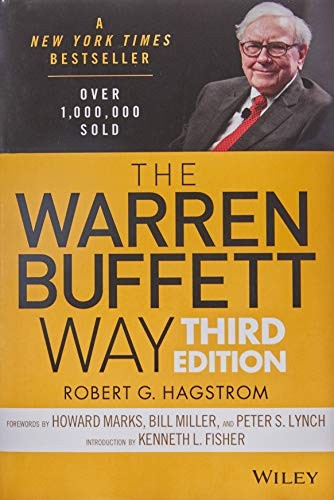
The Warren Buffett Way is Robert Hagstrom's systematic account of how Warren Buffett thinks about investing. First published in 1994 and updated since, it organizes Buffett's approach into a coherent set of principles drawn from his annual letters, interviews, and public statements. Hagstrom's contribution is translation: he takes what Buffett said over decades and arranges it into teachable frameworks rather than leaving it scattered across decades of shareholder letters.
The core of the book is twelve investing tenets organized into four categories: business tenets (understand the business, favor consistent operating history, look for favorable long-term prospects), management tenets (rational capital allocation, candor with shareholders, resistance to the institutional imperative), financial tenets (high return on equity with minimal debt, substantial owner earnings, high profit margins), and value tenets (determine the value of the business and buy it at a meaningful discount). Each tenet is illustrated through Buffett's actual investments in companies like Coca-Cola, The Washington Post, GEICO, and American Express.
Hagstrom also covers Buffett's intellectual lineage: the influence of Benjamin Graham's margin-of-safety framework, Philip Fisher's qualitative assessment of management and competitive position, and Charlie Munger's push toward paying reasonable prices for great businesses rather than bargain prices for mediocre ones. The synthesis is what distinguishes Buffett from pure Graham disciples — he evolved the approach.
The book has limits. It's stronger on qualitative principles than on the quantitative mechanics of valuation. Some case studies feel dated given how much Berkshire has changed since 1994. But as a structured introduction to how a genuinely great investor reasons about business and capital, it holds up well. Hagstrom doesn't add noise by speculating about what Buffett would do today; he sticks to explaining what Buffett did and why, which makes the book more durable than most Buffett interpretations.
The big ideas
- 1.
Buffett thinks like a business owner, not a stock trader. He buys a portion of a business and expects to hold it for a very long time.
- 2.
Consistent operating history matters more than recent results. A business that has performed well across economic cycles is more predictable than one with one great year.
- 3.
Rational capital allocation is one of the most underrated management qualities. CEOs who reinvest at high returns on equity compound value faster than those who diversify aimlessly.
