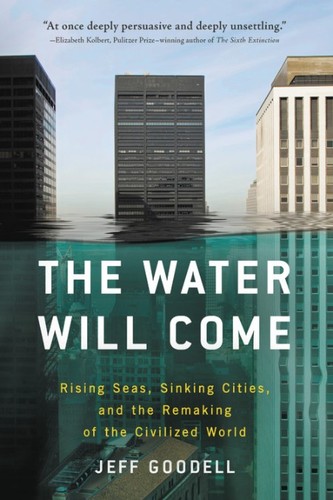
Talk to The Water Will Come: Rising Seas, Sinking Cities, and the Remaking of the Civilized World like its author wrote you back.
Get the ideas that fit your life — not generic summaries.
- Chat with the book
- Audiobook-style main ideas
- Adapts to your life and goals
- Helps you take action
The Water Will Come: Rising Seas, Sinking Cities, and the Remaking of the Civilized World, in detail
Jeff Goodell spent years traveling to the places most threatened by rising seas — Miami, Rotterdam, Lagos, Dhaka, Venice, the Marshall Islands — and The Water Will Come is the result of that reporting. His thesis is blunt: the seas are rising faster than most official projections acknowledge, and the cities humanity has built along coastlines over centuries will be partially or entirely underwater within the lifetimes of children alive today. This is not a distant hypothetical. It is already happening.
The book is organized around places and people rather than data tables. Goodell sits with real estate developers in Miami who are still selling luxury condos on land that will flood within decades. He visits Rotterdam, which has spent billions building flood infrastructure and has accepted that living with water, rather than fighting it, is the only viable long-term strategy. He reports from the Marshall Islands, where the question is not whether the islands will be uninhabitable but when. Each location illuminates a different dimension of the problem: denial, adaptation, migration, loss.
The science underneath the reporting is carefully translated. Goodell explains ice sheet dynamics, thermal expansion, storm surge amplification, and the difference between optimistic and pessimistic sea level projections. He is honest that the upper end of the projection range — which most planners quietly dismiss — carries real probability. The political chapter is particularly sharp: flood insurance programs distort incentives, infrastructure investment lags by decades, and elected officials have strong reasons to defer the hardest conversations.
What distinguishes this book from much climate writing is its refusal to treat adaptation as a failure or a concession. Goodell argues that retreat — moving people and infrastructure away from flood zones — is ultimately unavoidable for much of the world's coastline, and that the question is whether we do it in an organized, equitable way or in chaos after the next catastrophic storm. The book is sobering rather than panicked, and more useful for it.
The big ideas
- 1.
Sea levels are rising from two sources: melting ice sheets and glaciers, and thermal expansion of warming ocean water. Both are accelerating.
- 2.
The upper range of sea level projections — 6 to 9 feet by 2100 — is dismissed by most planners but is supported by real physical possibility and would be catastrophic.
- 3.
Miami is one of the most vulnerable major cities on Earth. It sits on porous limestone that makes seawalls ineffective and is surrounded by water on three sides.
