The Water Will Come: Rising Seas, Sinking Cities, and the Remaking of the Civilized World by Jeff Goodell is a 2017 science book about climate change, sea level rise, urban vulnerability. Sea levels are rising from two sources: melting ice sheets and glaciers, and thermal expansion of warming ocean water. Both are accelerating.
Summary
Jeff Goodell spent years traveling to the places most threatened by rising seas — Miami, Rotterdam, Lagos, Dhaka, Venice, the Marshall Islands — and The Water Will Come is the result of that reporting. His thesis is blunt: the seas are rising faster than most official projections acknowledge, and the cities humanity has built along coastlines over centuries will be partially or entirely underwater within the lifetimes of children alive today. This is not a distant hypothetical. It is already happening.
The book is organized around places and people rather than data tables. Goodell sits with real estate developers in Miami who are still selling luxury condos on land that will flood within decades. He visits Rotterdam, which has spent billions building flood infrastructure and has accepted that living with water, rather than fighting it, is the only viable long-term strategy. He reports from the Marshall Islands, where the question is not whether the islands will be uninhabitable but when. Each location illuminates a different dimension of the problem: denial, adaptation, migration, loss.
The science underneath the reporting is carefully translated. Goodell explains ice sheet dynamics, thermal expansion, storm surge amplification, and the difference between optimistic and pessimistic sea level projections. He is honest that the upper end of the projection range — which most planners quietly dismiss — carries real probability. The political chapter is particularly sharp: flood insurance programs distort incentives, infrastructure investment lags by decades, and elected officials have strong reasons to defer the hardest conversations.
What distinguishes this book from much climate writing is its refusal to treat adaptation as a failure or a concession. Goodell argues that retreat — moving people and infrastructure away from flood zones — is ultimately unavoidable for much of the world's coastline, and that the question is whether we do it in an organized, equitable way or in chaos after the next catastrophic storm. The book is sobering rather than panicked, and more useful for it.
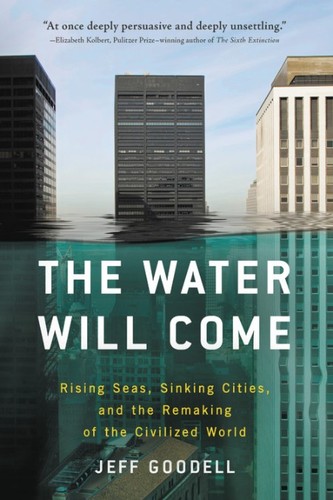
Talk to The Water Will Come: Rising Seas, Sinking Cities, and the Remaking of the Civilized World like its author wrote you back.
Get the ideas that fit your life — not generic summaries.
- Chat with the book
- Audiobook-style main ideas
- Adapts to your life and goals
- Helps you take action
Key takeaways
- 1.
Sea levels are rising from two sources: melting ice sheets and glaciers, and thermal expansion of warming ocean water. Both are accelerating.
- 2.
The upper range of sea level projections — 6 to 9 feet by 2100 — is dismissed by most planners but is supported by real physical possibility and would be catastrophic.
- 3.
Miami is one of the most vulnerable major cities on Earth. It sits on porous limestone that makes seawalls ineffective and is surrounded by water on three sides.
- 4.
Rotterdam offers a model for living with water rather than fighting it: floating buildings, water plazas, massive storm barriers. But it required political will sustained over generations.
- 5.
Flood insurance programs in the US subsidize development in flood-prone areas, creating a moral hazard that puts both homeowners and taxpayers at long-term risk.
- 6.
The Marshall Islands and other low-lying Pacific nations face complete loss of territory. Their governments are already planning for the migration of entire populations.
- 7.
Managed retreat — planned, subsidized relocation of people away from flood zones — is politically toxic but ultimately unavoidable for the most vulnerable areas.
- 8.
The populations least responsible for climate change face the greatest coastal flood risk. The geography of vulnerability is deeply unequal.
Discussion questions
Use these on your own, with a book club, or as chat starters in Superbook. Book club version, ready to copy or print →
- 1.
Goodell argues that retreat from flood zones is inevitable for many communities. What would make that process equitable, and who should pay for it?
- 2.
Miami developers continue selling coastal real estate while scientists warn of impending inundation. How do you explain that disconnect, and who bears responsibility for it?
- 3.
Rotterdam has invested massively in flood adaptation. What makes some cities capable of that kind of long-range planning while others can't manage it?
- 4.
The Marshall Islands face disappearance as a nation. What obligations do high-emitting countries have to those island nations?
- 5.
Goodell shows that the official sea level projections used for planning are often the conservative midpoint rather than the higher-end plausible scenarios. Is that appropriate, or is it a form of institutional denial?
- 6.
How has living near water — ocean, river, or lake — shaped your sense of place? Does reading about sea level rise change that relationship?
- 7.
The book documents how flood insurance creates perverse incentives. Are there other areas of public policy where insurance or subsidies are quietly making long-term problems worse?
- 8.
Goodell visits communities that have already been displaced by flooding. What does losing a place — a neighborhood, a city, a homeland — cost beyond the material?
- 9.
Which is the more honest response to sea level rise: aggressive emissions reduction, adaptation investment, or planned retreat? Can you make a case for prioritizing one?
- 10.
The book was published in 2017. How has the situation changed in the years since, in your view?
- 11.
Who do you think should bear the cost of relocating communities displaced by sea level rise — local governments, national governments, fossil fuel companies, or all consumers of carbon energy?
- 12.
Goodell suggests the hardest truth is that some coastal cities cannot be saved. If you lived in one of those cities, how would you want your leaders to communicate that reality?
Themes
Frequently asked questions
-
Is The Water Will Come worth reading?
Yes, particularly if you want to understand sea level rise as it affects real places and real people rather than through abstract projections. Goodell's on-the-ground reporting makes the science concrete. It is sobering but not hopeless — the Rotterdam and managed-retreat chapters offer frameworks for thinking about response.
-
How long does it take to read The Water Will Come?
Around five to six hours at average reading pace. The chapters are organized by location, which makes it easy to read in segments.
-
What is the main argument of The Water Will Come?
That sea level rise is faster and more dangerous than official planning acknowledges, that denial and financial incentives are delaying necessary action, and that managed retreat — not just seawalls — will be essential for the most vulnerable coastal communities.
-
Who should read this book?
Anyone who lives in or near a coastal city, anyone interested in climate policy, and anyone who wants to understand how institutions respond (or fail to respond) to long-term existential threats. It is also useful background for infrastructure planners, real estate investors, and local politicians.
-
Does the book offer solutions, or is it just alarming?
Both. Goodell documents the scale of the problem honestly and does not minimize it. But he also spends significant time on Rotterdam's adaptation model and the concept of managed retreat. The book argues that informed, proactive response is possible and worth fighting for.
Similar books
The Sixth Extinction: An Unnatural History
Elizabeth Kolbert
This Changes Everything: Capitalism vs. The Climate
Naomi Klein
The Uninhabitable Earth: Life After Warming
David Wallace-Wells
Silent Spring
Rachel Carson
