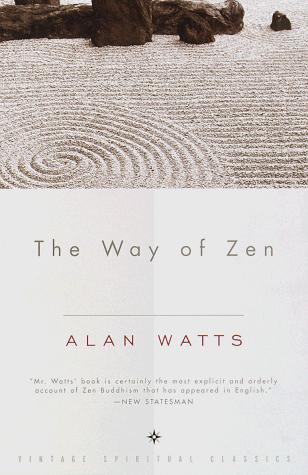
Talk to The Way of Zen like its author wrote you back.
Get the ideas that fit your life — not generic summaries.
- Chat with the book
- Audiobook-style main ideas
- Adapts to your life and goals
- Helps you take action
The Way of Zen, in detail
The Way of Zen was Alan Watts' most widely read and carefully argued work, published in 1957 at a time when Zen was largely unknown to English-speaking audiences. It was one of the primary texts that introduced Zen and related Asian thought to the West, read avidly by the Beat generation writers, the early counterculture, and generations of students since. Watts had an unusual background — trained in Anglican theology, deeply immersed in Asian thought, without formal Zen training — and The Way of Zen reflects both his genuine learning and his capacity to communicate ideas that resist easy explanation.
The book is in two parts. The first provides the background of Zen: the Indian origins of Buddhism, the transmission to China and its encounter with Taoism, and the development of the distinctively Chinese and Japanese forms that Zen embodies. Watts is particularly good on the relationship between Zen and Taoism — the two traditions share a fundamental suspicion of language, concept, and deliberate striving, and together they form the deep context for what looks strange or paradoxical in Zen from a Western perspective.
The second part examines the principles and practice of Zen: the koan system, the mondo (question-and-answer between master and student), the relationship between Zen and the arts (archery, painting, the tea ceremony), and the phenomenology of satori — sudden enlightenment. Watts argues that what Zen masters are pointing at cannot be transmitted through language or instruction; the words and practices are fingers pointing at the moon. The key is to look at the moon, not the finger.
Watts' interpretations have been challenged by scholars and practitioners who argue he domesticated Zen for a Western audience, smoothing out its more demanding aspects. That criticism has merit. But The Way of Zen remains unsurpassed as an intellectual orientation to the tradition for readers who have no prior exposure to it, and its prose is among the finest Watts ever wrote.
The big ideas
- 1.
Zen grows from the meeting of Indian Buddhism and Chinese Taoism, inheriting from both a fundamental suspicion of language, concept, and deliberate striving.
- 2.
The koan — a question or situation that defies rational resolution — is a device for breaking the habitual pattern of conceptual thinking and opening direct awareness.
- 3.
Satori (sudden enlightenment) is not a gain but a recognition: seeing what was always already the case, without the overlay of conceptual interpretation.
