Talk to The Wealth of Nations like its author wrote you back.
Get the ideas that fit your life — not generic summaries.
- Chat with the book
- Audiobook-style main ideas
- Adapts to your life and goals
- Helps you take action
The Wealth of Nations, in detail
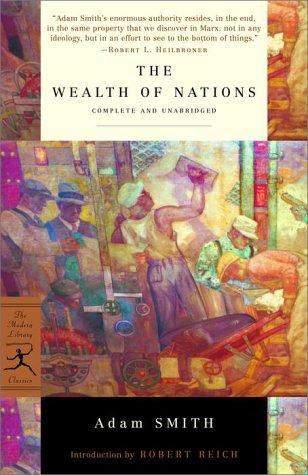
An Inquiry into the Nature and Causes of the Wealth of Nations, published in 1776, is Adam Smith's comprehensive account of how modern commercial economies work and what policies promote prosperity. Smith was a professor of moral philosophy at Glasgow, and the book is less the founding document of free-market ideology than it is usually taken to be — it is a careful, empirically grounded analysis of the mechanisms of economic growth, full of skepticism about merchants, manufacturers, and their ability to capture governments in their own interest.
The book opens with the famous analysis of the pin factory, used to illustrate the division of labor: a single worker making pins from start to finish produces a handful a day; a factory of ten workers, each specializing in one operation, produces thousands. The division of labor is the primary engine of productivity growth, and its extent is limited by the size of the market — which is why trade, both domestic and international, matters so much. The extension of markets allows further specialization, which produces further gains in output per worker, in a self-reinforcing dynamic.
Smith's theory of value and price is built around labor: goods exchange at prices that reflect the amount of labor required to produce them, and wages, rent, and profit are the three components into which the price of any commodity resolves. His account of how wages, profit, and rent are determined in competitive markets — and how they diverge from competition in monopolistic or politically protected ones — is the analytical core of the book. Smith is consistently hostile to monopoly, to the mercantile system that restricts imports to protect domestic producers, and to the collusion of employers who use their organizational advantage to suppress wages.
The famous "invisible hand" passage — which appears once, almost in passing — describes how individuals pursuing their own interest are led to promote the public interest without intending to. Smith is more cautious about this mechanism than his popularizers have been. The book includes extended arguments for public investment in education, infrastructure, and institutions that markets will not provide, and its analysis of the obstacles to competition is at least as prominent as its celebration of markets. The Wealth of Nations is best read as a foundational work of empirical political economy rather than as a manifesto, and reading it in full tends to complicate the uses to which it has been put.
The big ideas
- 1.
The division of labor is the primary source of productivity growth; specialization allows workers to produce vastly more than they could working alone, but its extent is limited by the size of the market.
- 2.
The self-interested pursuit of profit, in competitive markets, tends to channel resources toward their most productive uses — the mechanism Smith describes as the invisible hand.
- 3.
Monopoly is the enemy of prosperity; Smith is consistently critical of merchants and manufacturers who seek government protection from competition, calling it a conspiracy against the public interest.
