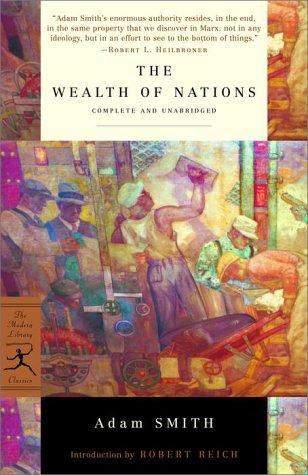
The Wealth of Nations by Adam Smith is a 1776 economics book about free markets, division of labor, political economy. The division of labor is the primary source of productivity growth; specialization allows workers to produce vastly more than they could working alone, but its extent is limited by the size of the market.
Summary
An Inquiry into the Nature and Causes of the Wealth of Nations, published in 1776, is Adam Smith's comprehensive account of how modern commercial economies work and what policies promote prosperity. Smith was a professor of moral philosophy at Glasgow, and the book is less the founding document of free-market ideology than it is usually taken to be — it is a careful, empirically grounded analysis of the mechanisms of economic growth, full of skepticism about merchants, manufacturers, and their ability to capture governments in their own interest.
The book opens with the famous analysis of the pin factory, used to illustrate the division of labor: a single worker making pins from start to finish produces a handful a day; a factory of ten workers, each specializing in one operation, produces thousands. The division of labor is the primary engine of productivity growth, and its extent is limited by the size of the market — which is why trade, both domestic and international, matters so much. The extension of markets allows further specialization, which produces further gains in output per worker, in a self-reinforcing dynamic.
Smith's theory of value and price is built around labor: goods exchange at prices that reflect the amount of labor required to produce them, and wages, rent, and profit are the three components into which the price of any commodity resolves. His account of how wages, profit, and rent are determined in competitive markets — and how they diverge from competition in monopolistic or politically protected ones — is the analytical core of the book. Smith is consistently hostile to monopoly, to the mercantile system that restricts imports to protect domestic producers, and to the collusion of employers who use their organizational advantage to suppress wages.
The famous "invisible hand" passage — which appears once, almost in passing — describes how individuals pursuing their own interest are led to promote the public interest without intending to. Smith is more cautious about this mechanism than his popularizers have been. The book includes extended arguments for public investment in education, infrastructure, and institutions that markets will not provide, and its analysis of the obstacles to competition is at least as prominent as its celebration of markets. The Wealth of Nations is best read as a foundational work of empirical political economy rather than as a manifesto, and reading it in full tends to complicate the uses to which it has been put.
Talk to The Wealth of Nations like its author wrote you back.
Get the ideas that fit your life — not generic summaries.
- Chat with the book
- Audiobook-style main ideas
- Adapts to your life and goals
- Helps you take action
Key takeaways
- 1.
The division of labor is the primary source of productivity growth; specialization allows workers to produce vastly more than they could working alone, but its extent is limited by the size of the market.
- 2.
The self-interested pursuit of profit, in competitive markets, tends to channel resources toward their most productive uses — the mechanism Smith describes as the invisible hand.
- 3.
Monopoly is the enemy of prosperity; Smith is consistently critical of merchants and manufacturers who seek government protection from competition, calling it a conspiracy against the public interest.
- 4.
The mercantilist system — protectionism and export promotion — enriches merchants and manufacturers at the expense of consumers and trading partners; free trade raises living standards on both sides.
- 5.
Wages are determined by the relative bargaining power of workers and employers, and employers have a structural organizational advantage that tends to hold wages down in the absence of competition.
- 6.
Capital accumulation enables the division of labor: investment in tools, machinery, and organization is what allows specialization, and saving is therefore productive rather than wasteful.
- 7.
Smith supports public provision of education, infrastructure, and legal institutions that markets will not provide and that are prerequisites for the market system to function.
- 8.
The wealth of a nation is not its stock of gold and silver but its productive capacity — the ability of its labor and capital to produce goods and services that satisfy human wants.
Discussion questions
Use these on your own, with a book club, or as chat starters in Superbook. Book club version, ready to copy or print →
- 1.
Smith's pin factory example has become iconic. What does the division of labor look like in an economy dominated by services and knowledge work rather than manufacturing?
- 2.
Smith argues that merchants and manufacturers systematically capture governments to protect themselves from competition. How does that argument look against the backdrop of contemporary lobbying and industrial policy?
- 3.
The invisible hand is often invoked as Smith's central claim. Having read more of the book, do you think that invocation is accurate, or does it distort what Smith actually argued?
- 4.
Smith supports free trade as beneficial to both trading partners. How do you reconcile that argument with the evidence that trade liberalization has produced concentrated losses as well as diffuse gains?
- 5.
Smith says employers have an organizational advantage that holds wages below competitive levels. What mechanisms in contemporary labor markets amplify or diminish that advantage?
- 6.
Smith was writing before industrialization fully arrived. Which of his observations depend on the specific economic conditions of the 1770s, and which feel like general claims about market economies?
- 7.
The book includes a detailed argument for public investment in education. How does Smith's rationale for public education relate to contemporary debates about human capital and inequality?
- 8.
Smith was a moral philosopher who had previously written The Theory of Moral Sentiments. Does knowing that context change how you read the Wealth of Nations?
- 9.
Smith treats self-interest as the engine of the market system. What assumptions about human psychology does that model make, and where do they hold and where do they fail?
- 10.
The Wealth of Nations is often cited by both free-market advocates and critics of capitalism. What does it mean that the same text can support such different readings?
- 11.
How does Smith's analysis of the relationship between productivity growth and wages relate to contemporary debates about whether workers share in economic growth?
- 12.
Smith argues that the wealth of nations is productive capacity, not gold reserves. How does that argument translate to contemporary debates about debt, austerity, and GDP?
Themes
Frequently asked questions
-
What is The Wealth of Nations about?
It is Adam Smith's comprehensive analysis of how commercial economies work, focusing on the division of labor as the engine of productivity, the role of markets in coordinating economic activity, the damage done by monopoly and mercantilist restrictions, and the conditions — including public investment in education and infrastructure — that markets require to function well.
-
Is The Wealth of Nations worth reading in full?
The core argument is in Books I–III and is rewarding to read in full; Books IV and V, which cover mercantilism and public finance in detail, are denser and most general readers can read selectively. The full text rewards specialists and historians but is more than most non-economists need.
-
Was Adam Smith a free-market ideologue?
Not straightforwardly. Smith supported free markets and free trade but was sharply critical of merchants seeking protection, skeptical of unregulated financial markets, and supportive of public investment and regulation where markets fail. He is more empirical and less ideological than his reputation suggests.
-
What does 'invisible hand' actually mean in The Wealth of Nations?
The phrase appears once, describing how a merchant who invests domestically rather than abroad promotes national production without intending to — led by an invisible hand to serve the public interest. It is a specific, limited observation, not the sweeping claim that all market outcomes are optimal that it is often taken to mean.
-
How long does The Wealth of Nations take to read?
The full text is around 900 pages and roughly 380,000 words — 25 or more hours at average reading pace. Most readers benefit from a good abridged edition or a selective reading guided by their specific interests.