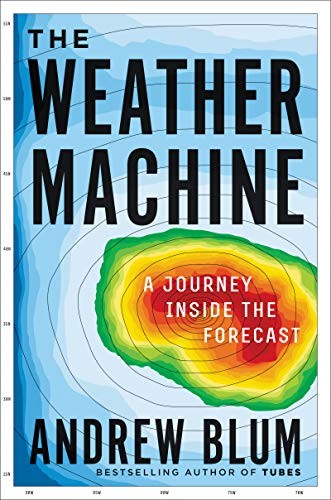
Talk to The Weather Machine: A Journey Inside the Forecast like its author wrote you back.
Get the ideas that fit your life — not generic summaries.
- Chat with the book
- Audiobook-style main ideas
- Adapts to your life and goals
- Helps you take action
What it argues
The Weather Machine is Andrew Blum's account of how modern weather forecasting actually works — not the phone app that tells you tomorrow will be partly cloudy, but the vast physical and computational infrastructure behind that prediction. Blum, who previously wrote Tubes about the physical infrastructure of the internet, approaches meteorology as a beat reporter interested in systems: who built this, where does the data come from, and how does a forecast actually get made?
The book follows three interconnected stories. First, the history of weather observation and numerical weather prediction, from the Bjerknes family's Bergen school in early twentieth-century Norway to the postwar development of computers fast enough to solve the equations of atmospheric physics in near real time. Second, the physical infrastructure of the current forecasting system — the satellites, radiosondes, ocean buoys, and weather stations that feed continuous data into forecast models. Third, the international cooperation that makes the system possible: the World Meteorological Organization, the ECMWF's forecasting center in Reading, and the extraordinary fact that weather data is shared freely between countries that share almost nothing else.
What it gets right
- 1.
Modern weather forecasts are produced by numerical models that solve atmospheric physics equations — computing the future state of the atmosphere from millions of current observations.
- 2.
Weather data is one of the few things shared freely between nearly all nations, including geopolitical rivals, because everyone benefits from global observation coverage.
- 3.
The ECMWF, based in Reading, England, produces forecasts widely considered the world's most accurate and is a rare example of successful international scientific infrastructure.
What it covers
Who wrote it
Andrew Blum is a journalist and author who writes about the physical infrastructure of digital and scientific systems. His first book, Tubes: A Journey to the Center of the Internet, investigated the undersea cables, data centers, and network exchange points that constitute the internet's physical layer. He has written for Wired, The New Yorker, and other publications. The Weather Machine, published in 2019, applies the same infrastructure-focused lens to meteorology, tracing the global observation networks and computing systems behind modern weather forecasting.
