The Weather Machine: A Journey Inside the Forecast by Andrew Blum is a 2019 science book about meteorology, global infrastructure, climate science. Modern weather forecasts are produced by numerical models that solve atmospheric physics equations — computing the future state of the atmosphere from millions of current observations.
Summary
The Weather Machine is Andrew Blum's account of how modern weather forecasting actually works — not the phone app that tells you tomorrow will be partly cloudy, but the vast physical and computational infrastructure behind that prediction. Blum, who previously wrote Tubes about the physical infrastructure of the internet, approaches meteorology as a beat reporter interested in systems: who built this, where does the data come from, and how does a forecast actually get made?
The book follows three interconnected stories. First, the history of weather observation and numerical weather prediction, from the Bjerknes family's Bergen school in early twentieth-century Norway to the postwar development of computers fast enough to solve the equations of atmospheric physics in near real time. Second, the physical infrastructure of the current forecasting system — the satellites, radiosondes, ocean buoys, and weather stations that feed continuous data into forecast models. Third, the international cooperation that makes the system possible: the World Meteorological Organization, the ECMWF's forecasting center in Reading, and the extraordinary fact that weather data is shared freely between countries that share almost nothing else.
Blum writes with enthusiasm for the material world. He visits the ECMWF, attends a weather balloon launch, and goes to see the satellite that takes the images behind every weather forecast. His strength is making infrastructure legible and interesting. The science is explained accessibly without being dumbed down.
What the book reveals is that weather forecasting is both a scientific triumph — ten-day forecasts that would have been impossible in 1980 are now reliable — and a fragile one. The system depends on data sharing across national boundaries, on funding for satellites and observational networks, and on international institutions that are under political pressure. The Trump administration's threats to withdraw from international weather data agreements, which Blum covers, are a reminder that the infrastructure behind the forecast is not as permanent as it seems.
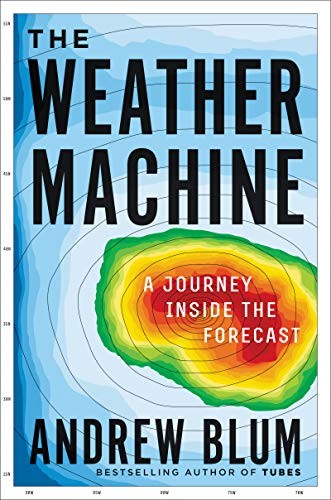
Talk to The Weather Machine: A Journey Inside the Forecast like its author wrote you back.
Get the ideas that fit your life — not generic summaries.
- Chat with the book
- Audiobook-style main ideas
- Adapts to your life and goals
- Helps you take action
Key takeaways
- 1.
Modern weather forecasts are produced by numerical models that solve atmospheric physics equations — computing the future state of the atmosphere from millions of current observations.
- 2.
Weather data is one of the few things shared freely between nearly all nations, including geopolitical rivals, because everyone benefits from global observation coverage.
- 3.
The ECMWF, based in Reading, England, produces forecasts widely considered the world's most accurate and is a rare example of successful international scientific infrastructure.
- 4.
Forecast skill has improved dramatically over fifty years: today's five-day forecast is roughly as accurate as yesterday's one-day forecast was in 1980.
- 5.
Weather satellites are the single most important data source for global forecasts, and their continuous operation depends on expensive programs that governments must choose to fund.
- 6.
Radiosondes — small instruments carried aloft on weather balloons — are launched twice daily from hundreds of stations worldwide, providing vertical atmospheric profiles that satellites cannot.
- 7.
Political threats to international data-sharing agreements would degrade forecast accuracy for everyone, illustrating that the benefits of global infrastructure cooperation are easy to take for granted and hard to recover once lost.
Discussion questions
Use these on your own, with a book club, or as chat starters in Superbook. Book club version, ready to copy or print →
- 1.
Blum frames weather forecasting as a public good that depends on international cooperation. What other global systems share this structure, and how vulnerable are they?
- 2.
The book reveals that the ten-day forecast has become genuinely useful within living memory. What does the history of forecast improvement suggest about what other scientific predictions might become reliable in the future?
- 3.
Weather data is shared globally even between hostile nations. Do you find that inspiring, or does it illustrate something about what kinds of cooperation are actually achievable versus what political actors claim is impossible?
- 4.
Blum visits the ECMWF in Reading, a genuinely international organization. How much of its success do you think comes from being European rather than American or globally headquartered?
- 5.
The Trump administration threatened to withdraw from international weather data agreements. Should weather data and related scientific infrastructure be insulated from political disruption, and if so, how?
- 6.
The book focuses heavily on numerical weather prediction — computers solving physics equations. What does this success tell us about the potential of computational approaches to other complex systems?
- 7.
Blum previously wrote a book about the physical internet. What does treating both internet and weather as physical infrastructure rather than abstract systems reveal about how we misunderstand both?
- 8.
The forecast you see on your phone is a simplification of outputs that took decades of infrastructure to produce. Does knowing that change how you use forecasts or how you think about the information economy generally?
- 9.
The book covers the competitive relationship between the ECMWF and the American National Weather Service. Is competition between national meteorological agencies good for forecast quality, or does it risk duplicating effort?
- 10.
Weather affects agriculture, aviation, energy, insurance, and shipping. Who do you think has the most at stake in continued improvements in forecast accuracy?
- 11.
What is the most important thing governments should do to protect and improve global weather forecasting infrastructure, based on what this book describes?
Themes
Frequently asked questions
-
What is The Weather Machine about?
It is a reported account of how modern weather forecasting works — the satellites, weather balloons, ocean buoys, supercomputers, and international data-sharing agreements that produce the forecast you see on your phone. It is less about climate and more about the mechanics and history of meteorology.
-
Is this a book about climate change?
Not primarily. Weather and climate are related but different topics, and Blum is focused on the forecasting system rather than long-term climate trends. The uninhabitable earth is a better choice if you want climate change coverage.
-
How long does it take to read The Weather Machine?
Around four hours. At 240 pages it is one of the shorter popular science books on its topic. The writing is accessible and moves quickly between history, field reporting, and explanation.
-
Who should read The Weather Machine?
Anyone curious about infrastructure, international scientific cooperation, or the history of how forecasting became possible. It is also a good book for people interested in the political economy of scientific public goods.
-
Is the science in the book accessible?
Yes. Blum is not a scientist and writes for a general audience. The explanation of numerical weather prediction is one of the clearest available in trade nonfiction.
Similar books

The Uninhabitable Earth: Life After Warming
David Wallace-Wells

Chaos: Making a New Science
James Gleick

The Information: A History, a Theory, a Flood
James Gleick
A Short History of Nearly Everything
Bill Bryson
