Talk to The Whole Shebang like its author wrote you back.
Get the ideas that fit your life — not generic summaries.
- Chat with the book
- Audiobook-style main ideas
- Adapts to your life and goals
- Helps you take action
What it argues
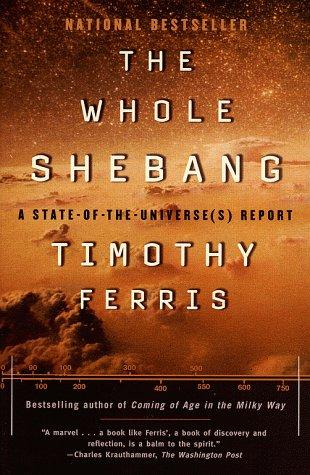
Timothy Ferris wrote The Whole Shebang in 1997 as a state-of-the-art survey of modern cosmology — what scientists knew, what they debated, and how they knew it. The book captures cosmology at a pivotal moment, just before the discovery of dark energy confirmed that the expansion of the universe was accelerating rather than slowing. Reading it today has the unusual quality of watching science operate in real time: the questions are right, some of the answers have since shifted, and the method on display remains the same.
Ferris organizes the book around the big cosmological questions: How did the universe begin? What is it made of? How will it end? He explains the evidence for the Big Bang, the significance of cosmic microwave background radiation, the flatness and horizon problems that motivated inflationary models, and the competing theories of large-scale structure. Dark matter and dark energy appear as active puzzles rather than settled facts, which gives the 1997 vintage a useful freshness — you see the uncertainty that has since partly resolved.
What it gets right
- 1.
The Big Bang is not an explosion in space but an expansion of space itself. Everything in the observable universe originated from an extremely hot, dense initial state roughly 13.8 billion years ago.
- 2.
Cosmic microwave background radiation is the oldest detectable signal in the universe — the afterglow of the Big Bang — and it has provided some of the strongest confirmation of standard cosmological models.
- 3.
Inflation theory proposes that the very early universe underwent an extremely rapid expansion, explaining why the large-scale structure looks so flat and uniform across vast distances.
What it covers
Who wrote it
Timothy Ferris is an American science writer and professor emeritus at the University of California, Berkeley. He is the author of more than ten books on cosmology and astronomy, including Coming of Age in the Milky Way, The Whole Shebang, and Seeing in the Dark. He has written for The New Yorker, Rolling Stone, and National Geographic, and has produced and narrated documentary films on astronomy. He was one of the principal voices of popular cosmology in the latter half of the twentieth century, known for making technical astrophysics accessible without sacrificing rigor.
