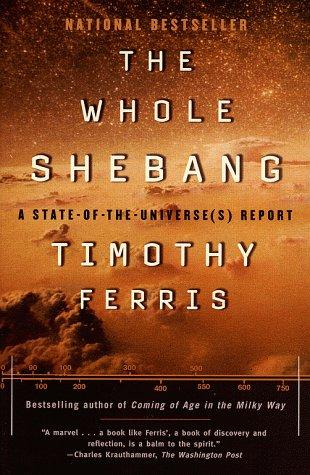
The Whole Shebang by Timothy Ferris is a 1997 science book about cosmology, big bang, dark matter. The Big Bang is not an explosion in space but an expansion of space itself. Everything in the observable universe originated from an extremely hot, dense initial state roughly 13.8 billion years ago.
Summary
Timothy Ferris wrote The Whole Shebang in 1997 as a state-of-the-art survey of modern cosmology — what scientists knew, what they debated, and how they knew it. The book captures cosmology at a pivotal moment, just before the discovery of dark energy confirmed that the expansion of the universe was accelerating rather than slowing. Reading it today has the unusual quality of watching science operate in real time: the questions are right, some of the answers have since shifted, and the method on display remains the same.
Ferris organizes the book around the big cosmological questions: How did the universe begin? What is it made of? How will it end? He explains the evidence for the Big Bang, the significance of cosmic microwave background radiation, the flatness and horizon problems that motivated inflationary models, and the competing theories of large-scale structure. Dark matter and dark energy appear as active puzzles rather than settled facts, which gives the 1997 vintage a useful freshness — you see the uncertainty that has since partly resolved.
One of Ferris's consistent strengths is explaining how cosmologists know what they claim to know. He doesn't just present conclusions; he describes the telescopes, the measurements, the redshift calculations, and the cross-checking that make a consensus credible. He is also candid about where cosmology shades into speculation — where the mathematics runs ahead of any possible observation. The philosophy of science is a quiet presence throughout.
The book asks readers to sit with the strangeness of it all: a universe that emerged from a hot dense state, contains more invisible matter than visible matter, and may be one of many. Ferris is not a sensationalist. His tone is measured and intellectually honest. Readers who want a glossy narrative will find him too careful; readers who want to understand the evidence behind the claims will find him exactly right.
Talk to The Whole Shebang like its author wrote you back.
Get the ideas that fit your life — not generic summaries.
- Chat with the book
- Audiobook-style main ideas
- Adapts to your life and goals
- Helps you take action
Key takeaways
- 1.
The Big Bang is not an explosion in space but an expansion of space itself. Everything in the observable universe originated from an extremely hot, dense initial state roughly 13.8 billion years ago.
- 2.
Cosmic microwave background radiation is the oldest detectable signal in the universe — the afterglow of the Big Bang — and it has provided some of the strongest confirmation of standard cosmological models.
- 3.
Inflation theory proposes that the very early universe underwent an extremely rapid expansion, explaining why the large-scale structure looks so flat and uniform across vast distances.
- 4.
Dark matter — matter that does not emit or interact with electromagnetic radiation — appears to constitute most of the universe's mass, inferred through gravitational effects on visible matter.
- 5.
Cosmology at its frontier is genuinely uncertain. Multiple competing models for large-scale structure and the ultimate fate of the universe were live debates in the 1990s and some remain unresolved.
- 6.
The observable universe is only the part we can see given the speed of light and the age of the universe. What lies beyond that horizon is inaccessible to observation by definition.
- 7.
Cosmologists must constantly distinguish between what the evidence supports and what the mathematics suggests. Not all mathematically elegant theories survive contact with observation.
- 8.
Reading a cosmology book from 1997 reveals how much the field has changed in thirty years and how the questions asked were already the right ones even when the answers were incomplete.
Discussion questions
Use these on your own, with a book club, or as chat starters in Superbook. Book club version, ready to copy or print →
- 1.
Ferris captures cosmology at a transitional moment — before dark energy was confirmed. How does reading a scientific book that has since been partly updated change your relationship to its claims?
- 2.
The Big Bang means space itself expanded, not that matter exploded into pre-existing space. How does that distinction change how you think about the question 'What was there before the Big Bang?'
- 3.
Inflation theory was introduced to solve specific mathematical problems with the Big Bang model. Does knowing a theory was invented to solve a problem make you more or less confident in it?
- 4.
Dark matter has never been directly detected, only inferred from its gravitational effects. How comfortable are you accepting scientific consensus built on indirect evidence?
- 5.
The observable universe is bounded by the speed of light and the age of the universe. Does the existence of an observational horizon trouble you, or does it just feel like a practical limitation?
- 6.
Ferris distinguishes between what the evidence supports and what the mathematics permits. Where do you draw the line between science and speculation?
- 7.
Cosmology deals in scales — billions of years, billions of light-years — that no human experience can make intuitive. How do you personally handle knowledge that cannot be felt or visualized?
- 8.
The book was written when the question of whether the universe is open, flat, or closed was genuinely open. What does it mean to live in a time when such a fundamental question was unanswered?
- 9.
Ferris describes the scientific community's debates and disagreements in real time. Does seeing science as a process of argument and revision make it feel more or less trustworthy to you?
- 10.
The possibility of a multiverse appears in the book as a mathematical implication rather than an observed fact. What would it take for you to find a multiverse hypothesis credible?
- 11.
What does it do to your sense of meaning or purpose to seriously contemplate a universe that is roughly 93 billion light-years across and almost 14 billion years old?
- 12.
If you could ask one cosmological question that current science cannot answer, what would it be?
Themes
Frequently asked questions
-
What is The Whole Shebang about?
It is a survey of cosmology as it stood in 1997, covering the Big Bang, inflation, dark matter, the large-scale structure of the universe, and the competing theories about how the universe will end. Ferris explains both the evidence and the ongoing debates.
-
Is The Whole Shebang still worth reading?
Yes, especially for readers interested in how science progresses. Some details have been updated by later discoveries — notably the confirmation of dark energy in 1998 — but the questions Ferris asks and the methods he describes remain relevant, and the book offers an unusually honest view of science in motion.
-
How long does it take to read?
Around six to seven hours. The book is approximately 400 pages, written for an educated lay audience. Some chapters on the mathematics of cosmological models require closer attention.
-
How is this different from A Brief History of Time?
Ferris is more focused on the current state of cosmological research and the sociology of how scientists work than on the historical narrative. He also writes at a slightly more detailed technical level, though the book is still accessible to non-scientists.
-
Who should read The Whole Shebang?
Readers who want to understand not just what cosmologists believe but how they arrived at those beliefs, and who enjoy seeing science as an ongoing argument rather than a set of settled answers. It pairs well with more recent cosmology books that show what happened next.