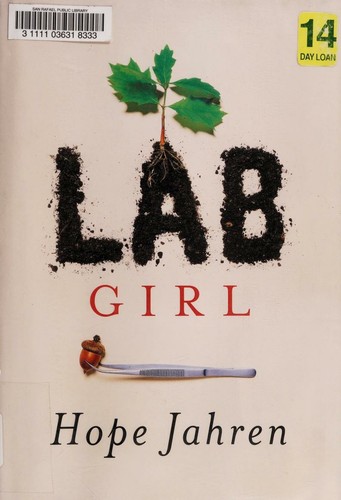
Talk to Lab Girl like its author wrote you back.
Get the ideas that fit your life — not generic summaries.
- Chat with the book
- Audiobook-style main ideas
- Adapts to your life and goals
- Helps you take action
What it argues
Hope Jahren is a geobiologist who has spent her career studying plants, and Lab Girl is her memoir of what that life actually looks like: the financial precarity of academic science, the long nights in poorly funded labs, the intensity of a vocation that seems unreasonable from the outside but feels like the only possible life from the inside. The book alternates between autobiographical narrative and short lyrical chapters on plant biology, and the two modes illuminate each other in unexpected ways.
The scientific chapters are some of the best popular writing about plants in recent memory. Jahren describes how a seed germinates, how a tree stores and spends its energy across seasons, how roots negotiate soil chemistry, how a leaf captures light. She writes with authority and genuine wonder, and she resists the temptation to anthropomorphize while still conveying the strangeness and tenacity of plant life. These chapters are short and can be read as standalone essays, but they gain weight in context.
What it gets right
- 1.
A seed germinates when conditions meet a threshold accumulated over time. Jahren uses this biology as a metaphor for the way a vocation, once it takes hold, is nearly impossible to suppress.
- 2.
Academic science in the United States runs on inadequate and unstable funding. Jahren's account of grant cycles, equipment improvisation, and financial insecurity is unsentimental and specific.
- 3.
Plants solve problems — competition for light, water scarcity, predation — with chemical and structural responses that are as sophisticated as anything in the animal kingdom, just on a different timescale.
What it covers
Who wrote it
Hope Jahren is an American geobiologist and geochemist who has held faculty positions at Johns Hopkins University, the University of Hawaii, and the University of Oslo, where she leads a research group studying plant physiology and paleoclimate. She has published more than 100 scientific papers and received three Fulbright Fellowships. Lab Girl, published in 2016, won the National Book Critics Circle Award for autobiography. Her second book, The Story of More, addresses climate change and human consumption. She lives and works in Oslo.
