Summary
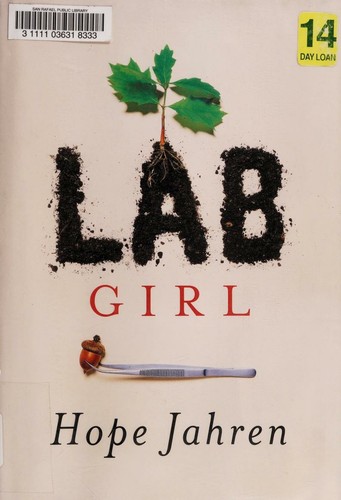
Hope Jahren is a geobiologist who has spent her career studying plants, and Lab Girl is her memoir of what that life actually looks like: the financial precarity of academic science, the long nights in poorly funded labs, the intensity of a vocation that seems unreasonable from the outside but feels like the only possible life from the inside. The book alternates between autobiographical narrative and short lyrical chapters on plant biology, and the two modes illuminate each other in unexpected ways.
The scientific chapters are some of the best popular writing about plants in recent memory. Jahren describes how a seed germinates, how a tree stores and spends its energy across seasons, how roots negotiate soil chemistry, how a leaf captures light. She writes with authority and genuine wonder, and she resists the temptation to anthropomorphize while still conveying the strangeness and tenacity of plant life. These chapters are short and can be read as standalone essays, but they gain weight in context.
The autobiographical narrative centers on Jahren's relationship with Bill, her lab partner and best friend since graduate school, and on her own struggles with bipolar disorder, pregnancy, and the slow process of building a scientific career while working in a field that has historically been hostile to women. The friendship with Bill is the emotional core of the book — a decades-long collaboration that involves genuine hardship, absurd improvisation, and a loyalty that Jahren describes without sentimentality.
Lab Girl is not a triumphalist science narrative. Jahren does not pretend the career has been smooth or that the institutional obstacles were minor. The book is instead an honest account of what sustains someone through difficulty: the work itself, a few essential relationships, and the habit of paying close attention to things that most people walk past. That the things she pays attention to happen to be plants makes it stranger and more interesting than most scientific memoirs.
Talk to Lab Girl like its author wrote you back.
Get the ideas that fit your life — not generic summaries.
- Chat with the book
- Audiobook-style main ideas
- Adapts to your life and goals
- Helps you take action
Key takeaways
- 1.
A seed germinates when conditions meet a threshold accumulated over time. Jahren uses this biology as a metaphor for the way a vocation, once it takes hold, is nearly impossible to suppress.
- 2.
Academic science in the United States runs on inadequate and unstable funding. Jahren's account of grant cycles, equipment improvisation, and financial insecurity is unsentimental and specific.
- 3.
Plants solve problems — competition for light, water scarcity, predation — with chemical and structural responses that are as sophisticated as anything in the animal kingdom, just on a different timescale.
- 4.
Long-term scientific collaboration, like the one Jahren describes with Bill, involves a kind of trust and interdependence that resembles and sometimes exceeds the intimacy of marriage.
- 5.
Bipolar disorder shaped Jahren's relationship to her work in ways she traces carefully, including the hypomanic periods that produced some of her most productive stretches and the crashes that followed.
- 6.
Women in STEM face institutional obstacles that Jahren documents through specific incidents rather than general claims, which makes the argument harder to dismiss.
- 7.
Paying close attention to a particular part of the natural world — plants, in Jahren's case — changes how you perceive time, persistence, and what counts as success.
- 8.
The scientific and the personal are not separate in Jahren's telling. Her understanding of plants and her understanding of her own life developed together and inform each other throughout.
Discussion questions
Use these on your own, with a book club, or as chat starters in Superbook.
- 1.
Jahren alternates between plant biology and personal narrative throughout the book. Did you find those two modes strengthened each other, or did one feel like an interruption of the other?
- 2.
The friendship with Bill is the emotional center of the book. What makes it unusual as a friendship, and what does Jahren seem to think it requires?
- 3.
Jahren's account of academic science funding is bleak. Did it change how you think about where scientific knowledge comes from and what it costs to produce?
- 4.
The plant chapters describe organisms that live very differently from animals — on different timescales, without locomotion, in fixed relationships to place. How did reading those chapters change what you noticed in the natural world afterward?
- 5.
Jahren writes about her bipolar disorder as part of her scientific identity, not separate from it. How do you think about the relationship between mental health and creative or intellectual work?
- 6.
Lab Girl describes a vocation — not just a job or a career but something that feels necessary. Do you have that relationship to any kind of work? What does it require of you?
- 7.
Jahren documents specific instances of sexism in academic science without turning them into the book's primary focus. Is that approach more or less persuasive than a more systematic treatment would be?
- 8.
Several of the plant chapters describe survival strategies — deep taproots, chemical defenses, storing energy against lean seasons. Which of those strategies resonates most with how you navigate difficult periods in your own life?
- 9.
Jahren grew up in rural Minnesota in a family where she was the first to pursue higher education. How much of what she describes as vocation seems like it comes from that background?
- 10.
The book ends with Jahren's son's birth. What does that ending seem to be saying about continuity, labor, and what we pass on?
- 11.
A recurring theme is the question of what justifies a life spent doing work that most people don't understand and that doesn't pay well. How does Jahren answer that question, and do you find her answer convincing?
- 12.
What's a tree, plant, or natural feature near where you live that you've walked past without really seeing? After reading the book, what do you think you'd notice if you stopped?
Themes
Frequently asked questions
-
Is Lab Girl worth reading?
Yes. It is one of the best memoirs about scientific life written in the last decade, and the plant biology chapters are remarkable popular science on their own. The combination of the two is what makes the book unusual.
-
How long does it take to read Lab Girl?
About five hours. The chapters are short and varied in mode — some narrative, some lyrical essay — so the pace changes frequently. Many readers report reading it in two or three sittings.
-
Is Lab Girl more memoir or popular science?
Genuinely both. Jahren gives roughly equal weight to her personal story and to the plant biology, and each informs the other. Readers who come for only one of the two are still likely to find value in the other.
-
Who should read Lab Girl?
Anyone interested in the reality of scientific careers, the biology of plants, or the form of the scientific memoir. It's also a useful book for anyone thinking about what a vocation feels like from the inside.
-
What's the most memorable part of Lab Girl?
Different readers point to different things — the chapter on seed germination, the account of driving cross-country with inadequate heat and no money, or the description of Jahren's bipolar episodes. The friendship with Bill is probably the part most readers remember longest.
Similar books
The Soul of an Octopus: A Surprising Exploration into the Wonder of Consciousness
Sy Montgomery

Educated: A Memoir
Tara Westover

When Breath Becomes Air
Paul Kalanithi

The Double Helix
James D. Watson
